


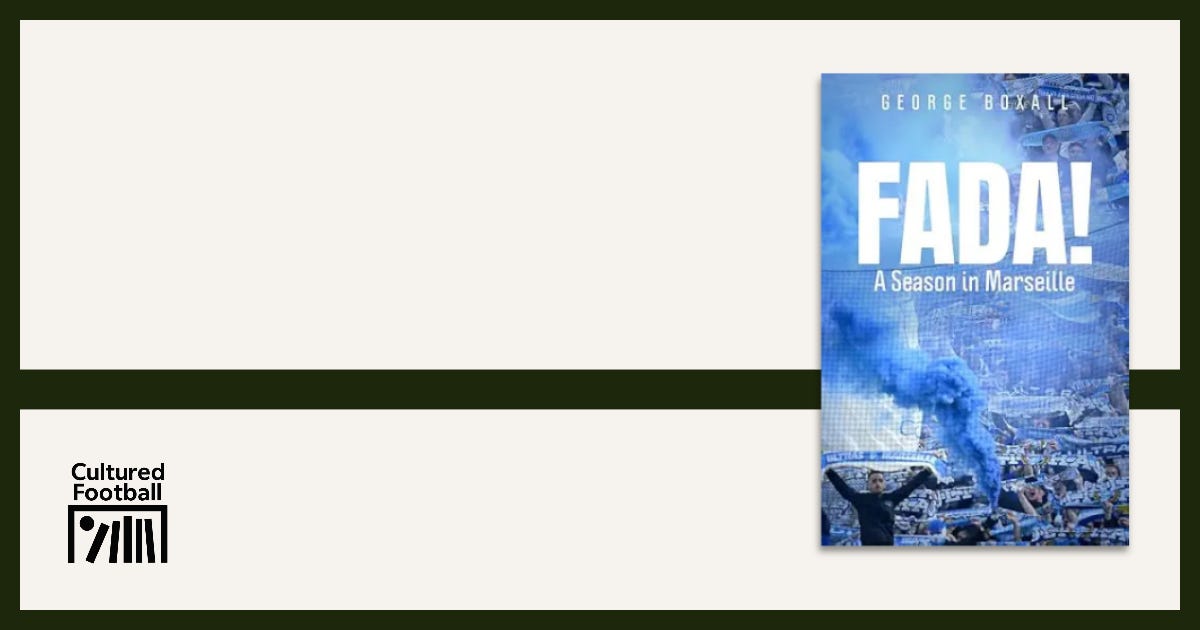
George Boxall’s first taste of Marseille came in 2023, when he travelled to the city to watch Brighton play in the Europa League. Struck by its intensity and the extraordinary atmosphere surrounding Olympique de Marseille, he returned in 2025 to live there and document a season under Roberto De Zerbi.
The result is FADA!, a book that looks beyond the fortunes of a football club to explore the people, politics and contradictions of a city where football is inseparable from everyday life.
We spoke to George about finding his place in Marseille, the culture of its supporters, the collapse of De Zerbi’s project and how writing the book changed his own relationship with football.
Q. Your first experience of Marseille came as a Brighton supporter in 2023. What was it about the city that made you want to return and eventually devote a book to it?
I was rather taken aback by the intensity of the city. Even when I stayed for a couple of days as an away supporter you could really sense a certain mystique amid the chaos and the hostility of the Vélodrome. You walk the streets and there’s an energy, sometimes the sense that the city is constantly arguing with itself. When I moved in 2025 I discovered the real warmth of people, and the way in which this club conditions people’s everyday lives. When you added Roberto De Zerbi and all the explosive characters at the football club, I really thought that this is the story I wanted to tell for the next few years in my writing.
Q. You pitched the book before the 2025/26 season began, without knowing how events would unfold. What was the book you originally imagined writing, and how different is it from the one you’ve ended up publishing?
I suppose the original idea was to write a behind-the-scenes account of the De Zerbi era at the club. At one point I was firmly convinced that his second season would at least bring a trophy. Either that, or it would all go up in flames. Yet I always felt the pull of the city itself, and the more time I spent there, the more I wanted to write about the people whose lives revolved around OM. I have always been fascinated by ultras in France since I moved in 2019, and in Marseille it’s a whole world in itself with five different groups so that was another big part of the cultural writing I’ve been trying to cultivate a bit more in this book.
Q. Fada is a wonderfully appropriate word for the relationship between Marseille and its football club. At what point did you realise that it also described your own growing obsession with the city?
As Jean-Claude Izzo says, Marseille isn’t really a city for tourists, because you have to “take part” for what you seek to really reveal itself. I understood that unconsciously at the start, but as the season started to fall apart I realised that OM had started to dictate my own life (and my terrible sleep pattern) a bit too much. There’s an evening where I go to see Marseille Champions League winner Éric Di Meco play bass in his Oasis tribute band, and afterwards all these kids are lighting a massive bonfire in Place Jean-Jaurès, in La Plaine, to protest against the far right on the eve of a municipal election. That all makes it into the book, without directly having anything to do with a football match. I was becoming just as caught up in the social and political life of the city. Every character in the book becomes a bit fada at one point, the writer included!
Q. You’ve described how football helped you find your place in Marseille, opening doors to conversations and friendships. What did those encounters teach you about the city that you would never have discovered simply by covering matches?
I think sometimes as football writers we can easily sit in a press stand, a conference, or at home, and recycle the same stories and transfer rumours about the same 22 multi-millionaires running around a football pitch every week. I think my goal was to be able to understand the lives of people around this sense of attachment. Speaking French helped, but football could give you a route into talking about someone’s childhood, their family, or a certain neighbourhood that has changed beyond recognition. There’s a certain warmth in the nostalgia, and the importance of belonging somewhere. These are also relationships that become friendships over time, and so that is difficult to cultivate if the beginning and ending of your experience of a place is limited to the stadium.
Q. Marseille is often portrayed through familiar clichés about passion, volatility and chaos. Having spent so much time there, what do you think outsiders most misunderstand about the city and its football club?
I’ve fallen into those clichés myself, and it’s easily done. There are social, economic and historical reasons behind what happens in a city; nowhere is just inherently chaotic. I think people also assume that there is a hostility to the place, that the city is violent or dangerous. It’s gotten a bad rap over the years, and a lot of that portrayal is tied up with racialised stereotypes about immigration in mainstream media. In fact it is more to do with being a city that the French state has left behind. Recently you have found the opposite: Marseille is the trendy new place to be, somewhere to move with your remote job and enjoy the Mediterranean lifestyle.
I find both quite frustrating because it’s either a city that outsiders fear, or a sort of rough and ready Mediterranean playground. But what about the people who have built their lives there? People who love it and are also struggling? The only way to avoid a cliché is to take the time to dig a little deeper and take people seriously.
Q. One of the most interesting aspects of your account is how you were falling in love with Marseille while some of the people you met were struggling with the changes taking place around them. Did that make you question or reassess your own romantic view of the city?
For sure, I talked with a friend after a game against Ajax and he captured that feeling very well. Marseille is a city which is gentrifying at lightning pace, entire neighbourhoods are changing and rents are rising. For some people it has meant that they had to move around their entire life, whilst seeing the impact of over-tourism in the summer and parts of their own lives that were disappearing. So of course it tempers a bit that romantic perception. These were also people I cared about, so I couldn’t write honestly about finding a home there without taking seriously their struggle to hold on to theirs.
Q. Marseille supporters seem to have an extraordinarily intense relationship with their club. What makes that relationship different from the one supporters have with clubs elsewhere?
I think you can find a similar relationship in other one-club cities. We always hear the comparison with Napoli, and I wouldn’t claim that Marseille supporters have a monopoly on passion. But in Marseille the club’s success is bound up with civic identity, and with how people feel their city is viewed by the rest of France.
There’s a language around OM of siege, betrayal, honour and revenge that seems to echo much older narratives. Victory comes as a form of vindication, while defeat can provoke a burning sense of injustice. Roberto De Zerbi, Pablo Longoria, and Medhi Benatia knew how to evoke this when talking about referees, the media, and creating a siege-like mentality at times. So I think that captures it quite well: winning becomes proof of the city’s worth, and losing can feel like another slight against it.
Each week on Cultured Football we pick the five great football stories from the previous seven days.
Q. You explore some difficult subjects in the book, particularly the response to Mason Greenwood’s arrival and the experiences of supporters who opposed it. Did researching these stories change the way you understood the idea of unconditional loyalty to a football club?
There was no way that I could write a book about Marseille during this era without addressing one of the biggest controversies concerning an English player in recent times. There were only so many times I could relitigate the controversy or argue with supporters or journalists about the subject, or uncomfortably bring the subject up again in a press conference. Of course, the web of communication around the player and the way he was normalised among the fanbase and in French football was in itself a troubling case study.
But this is why I thought speaking to Sara was really important. She described stepping away from supporting OM for two years after Greenwood’s arrival, and the abuse she and others received for opposing the signing. When a club occupies that much space in your life, what does it mean to walk away from those routines and relationships for your own values?
It was so refreshing to see someone like Sara speak with such moral clarity, it certainly made me question what we’re asking of people when we describe loyalty to a club as unconditional, and those that weaponise loyalty to a club for its own sporting success.
Q. You also devote attention to Marseille’s women’s team and its struggle to establish its own identity. What did that story reveal about the wider culture and priorities of Olympique de Marseille?
For an English reader, the rebrand is quite interesting. We’re used to Chelsea Women or Manchester United Women, whereas OM were trying to build a distinct identity as Les Marseillaises. Lyon have done the same thing in recent years. Les Marseillaises had just returned to the top division, and their first-ever match at the Vélodrome drew 35,713 people.
There was something infectious about that enthusiasm whilst the men’s team was collapsing. Honestly, it felt like a breath of fresh air. But local journalist Léna Bernard helped put it in perspective: for all OM’s stature and ambition, the women had spent far too long on the margins. Beyond Lyon’s success, French women’s football has struggled to build the infrastructure and stability it needs. For example, there had only been a collective bargaining agreement between the players and the league signed at the end of last season! You could, however, see the possibility of another Marseille, one capable of building patiently and giving more people a place in the club.
Q. Marseille has enjoyed extraordinary moments under Roberto De Zerbi, yet the project ultimately unravelled. Having followed the season so closely, do you think the club’s instability is largely a consequence of the people running it, or is there something about the expectations surrounding OM that makes sustained success particularly difficult?
The context and media ecosystem surrounding OM has always been a challenge. But blaming it all on the pressure surrounding the club would be rather reductive. I had only realised afterwards that I managed to capture, almost day by day, the collapse of an era which was really defined by the club president Pablo Longoria and his alliance with Medhi Benatia and Roberto De Zerbi. The club was already very reliant on the owner Frank McCourt underwriting losses for the last ten years. But when this very expensive project collapsed on the pitch it fractured this alliance, leaving behind the major financial problems that have engulfed the club this season. So yes, there was a major failure of leadership, infighting, and a huge waste of money which occurred under the watch of the American owner. You can’t blame all of that on the external forces at the club.
Q. You mention that one of your biggest challenges was deciding which events deserved attention and which could be left out. How did you approach turning such an unpredictable season into a coherent story?
It was quite difficult to pivot when all of this chaos was going on! The season literally starts with a dressing room fight between Jonathan Rowe and Adrien Rabiot away to Rennes, peaks with a win over PSG and being top of the league, and finishes by absolutely collapsing in Europe and Ligue 1. There was enough boardroom intrigue, a lot of toxicity between the media and the club, a lot of behind the scenes stuff that just couldn’t go in because the season was just so saturated with drama. I think you feel that rise and fall as I was writing a lot of as the season was going on, before going back and selecting what was more important to tell the story of the season, and the city, as a whole.
Q. Some of the most memorable passages you’ve shared have little to do with what happened on the pitch. There’s a wonderful account of supporters arguing late into the night about Chris Waddle, for example. When did you realise that these seemingly incidental encounters were just as important to the book as the football itself?
I spoke to a colleague, Mourad Aaerts, who had written a book in French about Marcelo Bielsa’s time at the club, and showed him some early passages. I think he reaffirmed what I was already sensing: my natural day-to-day interactions were already teaching me a lot more about the city and OM than just the matchdays. The more of myself and my experiences and memories I put into the book, the richer it became. Even if I didn’t think my perspective was particularly interesting to start with, I began to realise that other people found this outsider / insider dynamic quite interesting. So that was a major turning point for the style of the book.
Q. You reference the Marseille novelist Jean-Claude Izzo as an influence, particularly his ability to make the city a character in its own right. Were there other writers or books that influenced how you approached FADA!?
Since I’ve been able to read in French, I’ve really enjoyed their academic desire to understand football through the lens of sociology and politics. There’s not such a culture of reading about tactics or players. But there is a whole body of work which asks what the game means to the people that follow it. So initially it included writers like the anthropologist Christian Bromberger, and then Phillipe Broussard’s work on supporters around Europe. I thoroughly enjoyed working with Sébastien Louis on my chapter about ultras because he was one of my inspirations to write on that subject. Outside of football I love writers like Svetlana Alexievich and her work on oral history. The way you can collect individual voices and memories to build a much bigger portrait of a place or time period probably seeped into my way of writing FADA! as well. So it was nice to blend that with my very typical English style of correspondent reporting that I have developed over the last four years as a journalist.
Q. This is your first book, written while you were also working as a journalist. What proved most difficult about making that transition, and what did you discover about your own writing in the process?
I think one of the most difficult things was learning about pacing, because as a journalist your pieces are always self-contained. But it was being aware of the wider story, and that was difficult when the story kept changing from week to week. But writing FADA! has certainly changed my writing style. I think I’m a bit more liberated now to use colour, not be afraid to try a bit more scene-setting as long as I can keep whatever I’m doing grounded with people and their experiences.
Q. You arrived in Marseille to document a football club but ended up building a life there. Has writing FADA! changed your relationship with the city, or perhaps the way you think about football itself?
I do think about football and life differently. There is a simplicity to life despite the complex nature of Marseille: spending time with people, being outside, helping one another out. Okay, I might struggle to make ends meet, but I’m happy.
Football is my entire life, so why shouldn’t I have an intense relationship with it? When I return to the UK, I don’t see the Premier League in quite the same way. The passion is certainly there, but the prices and an increasingly individualised relationship with football make me feel more distant from it.
Q. Finally, for someone who has never visited Marseille or followed Olympique de Marseille closely, what do you hope they’ll take away from the book?
I hope they feel they’ve spent some time in Marseille and met people they might never otherwise have encountered. You don’t need to know OM’s results or players to understand wanting to belong somewhere, or caring deeply about something that occasionally makes your life miserable! I wanted to share a portrait of a city, without hiding its difficulties or contradictions. If someone finishes the book curious enough to visit, or with a better understanding of why this club means so much to people, I’d be happy.
About the author: George Boxall is a British football journalist and writer based in Marseille. His work explores the relationship between football, culture and society, with a particular interest in French football and supporter culture. Having moved to France in 2019, he has developed a distinctive approach to football writing that combines reporting with an interest in the people and communities surrounding the game. FADA! is his first book.
About the book: FADA! A Season in Marseille, published by Pitch Publishing, explores the extraordinary relationship between Olympique de Marseille and the city it represents. Following the turbulent Roberto De Zerbi era, Boxall combines first-hand reporting with encounters with supporters, historical context and reflections on life in Marseille. It is available for sale here.