


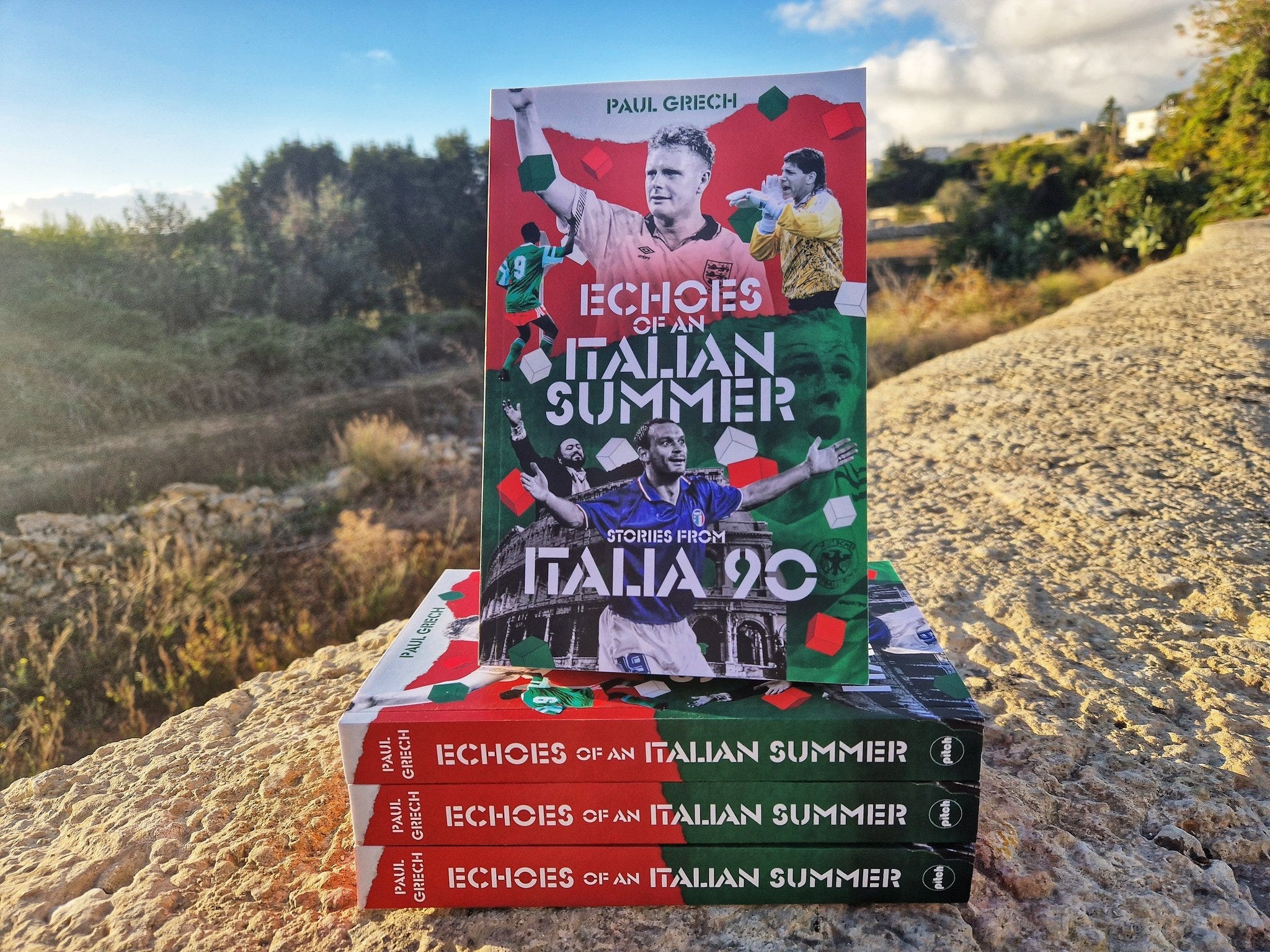
The following is an extract from the book Echoes of an Italian Summer: Stories from Italia 90 by Paul Grech and published by Pitch Publishing. It is available for purchase here.
Whatever hopes there had been for Cameroon ahead of the 1990 World Cup, a disappointing African Cup of Nations seemingly dashed them. True, there was a level of over confidence among the players, and no one wanted to get injured so close to the World Cup. Yet these were seen as excuses that papered over the reality that there was something missing from the squad.
That was the public opinion and that was how the Cameroon prime-minister Paul Biya saw it.
Roger Milla had been at the African Cup of Nations albeit only as a fan and a part-time consultant to the association. Earlier he had made a trip to Cameroon to play in a former team-mate’s testimonial. Despite his age, many felt that he had retired too early and let him know.
Again, Biya shared those views. So, a few days after the end of the disastrous African Cup of Nations, he called key people within the Cameroon FA for a meeting at his office during which it was agreed that Milla had to be in the squad for the World Cup. Once that was decided, Biya himself picked up his telephone and called Milla, urging him to reconsider his decision to retire.
The plea worked; Milla was in.
**
His career with the national team had been glory filled. He’d been there when they had last gotten to the World Cup in 1982 when they’d suffered elimination without losing any of their games. Twice he had led them to the title of African Champions. He was, to all intents and purposes, a national team legend.
Even though Milla’s inclusion was a boost, the doubts about their prospects remained. That much was evident by the Cameroonian federation’s choice of pre-World Cup base, what the players described as soldiers’ barracks in Sarajevo. Conditions were sparse and equipment basic. Apparently green-lit by coach Valery Nepomnyashchy who was more focused on ensuring that his men where well prepared physically for the coming challenge, the players found themselves doing drills typically reserved for soldiers.

Milla had his own, different, doubts. Asked whether he felt that he had the legs to play in such a competition, he replied candidly. “Not really, to be honest, but football’s not just a physical game. I’d always been an intelligent player, so I knew if I got into shape, I had a chance.”
“My first aim was to get fit, and then it would be up to the coach to decide whether I was good enough.”
He was not the only one with doubts; Nepomnyashchy himself also did not feel that Milla was up to it. Not only had the striker been imposed on him but there was constant pressure to pick him. “When I wasn’t playing they wanted him to put me through some really hard training sessions to get me into shape,” Milla confirmed. “But fortunately I was one of our best players in the pre-tournament friendlies, so I won him over on my own.”
If Nepomnyashchy had been forced by higher-ups into picking Milla, he found their backing when he faced criticism from within the team. Bordeaux’s Joseph-Antoine Bell was arguably the best African goalkeeper of his generation and had just been chosen as the second-best player in the French league. He was also highly vocal in his opinions, regardless of who they could offend. Asked about their prospects on the eve of the World Cup, he replied that Cameroon had “no chance of coping with Argentina, or any other team.”
Understandably, this was not well received. Bell, who had been widely expected to be the regular goalkeeper, was unceremoniously dropped from the starting eleven. Fortunately for them, Cameroon had a fine deputy in Thomas N’Kono. Indeed, when the International Federation of Football History & Statistics got to choose the African goalkeeper of the twentieth century, N’Kono came in second, Bell first.
In a 2020 interview, N’Kono shared his belief that he was ahead of his time. He’s right, and his performance against Argentina in the opening game of the World Cup proved that. A game that is more remembered for the tackles and physicality, as well as Cameroon’s surprising victory would probably have had a different outcome without N’Kono in goal. Not because he made any breath-taking saves – he didn’t – but simply because of how he played.
With Cameroon concentrated on making it impossible for Argentina to play through the centre and pushing them to the sides, the only option left for the South Americans was to fling in crosses. Where, inevitably, they found N’Kono willing to come out and catch them. His speed and agility gave him the courage needed to go against the convention at the time where goalkeepers were expected to stay on their line as much as possible. N’Kono was not like that.
N’Kono could read the game and was willing to use that to his advantage which sometimes meant rushing off his line to snuff out a chance before it had the opportunity to materialise. One of the reasons why Argentina didn’t have clearer shots at goal throughout the game was N’Kono’s ability to stop them before they could happen. It was a different way of being a goalkeeper, one that inspired a young boy called Gianluigi Buffon to pick up gloves.
Milla played the final ten minutes of that game as Cameroon tried to hang on with a player less (it would become two less in the final minute) yet his involvement was minimal.
That would not be the case in Cameroon’s second game. The opening exchanges had been rather lacklustre with Romania cautious not to open themselves up knowing that, having won their opening game, a draw could be enough to go through. Cameroon also weren’t willing to go on the offensive so both sides’ reluctance resulted in a rather staid game.
Nepomnyashchy, however, felt that his side could get more than a draw so early in the second half he put Milla on. The move paid off almost immediately. Milla had been on the field for just a handful of minutes when a ball was flung into the box in desperation more than anything else. The ball seemingly hung in the air which made it hard for the Romanian defender beneath it to clear. Milla saw his opportunity. As the ball fell, he barged in to get control and then fired past the goalkeeper.
It was a magnificent display of opportunistic attacking play. Minutes later, Milla showed another side to his game. He’d managed to win the ball just outside the penalty area and lobbed it towards his team-mate on the right-hand side of the box. A Cameroon striker rose with a Romanian defender but neither could get to it. Milla, however, had continued running and latched on to the loose ball before shooting with such accuracy and ferocity that the Romanian keeper couldn’t do anything. A beautiful mix of skill and finishing.
Whilst the goals were wildly different, the celebration wasn’t. On both instances, Milla went to dance in front of the corner flag in what was to become an iconic image from that World Cup. With good reason. Celebrations at the time were often muted, consisting of nothing more than raised fists, enthusiastic cheers and maybe a jump to signal exuberance. Not Milla, however, who celebrated the goal for what it was, a moment of pure joy and ecstasy.
In doing so he became a trailblazer of the modern goal celebration. He single-handedly injected a sense of confidence and flair onto the football field, forever changing the way goals were celebrated. From that point onward, the sheer ecstasy brought forth by scoring would be expressed with even greater fervour and emotion.
**
The goals had taken everyone by surprise – the television graphics listed the scorer as Miller – except those back in Cameroon who had exhibited such faith in Milla when they called him out of retirement. Now they could prepare for the knock-out phase since their two wins guaranteed qualification regardless of what happened in the final group game.
In fact, they actually finished top of their group despite a 4-0 thumping at the hands of the Soviet Union. Milla came on mid-way through the first half with Cameroon already two goals down but he could do little to influence proceedings.
The reward for finishing on top of Group E was a game against Colombia. The South Americans had been some people’s dark horses for the tournament but had barely scraped through as one of the best third placed sides. Still, they were hard to beat, favouring a patient build-up that kept opponents at bay.
Unsurprisingly, the game itself ended in a 0-0 draw with very few moments to excite fans. The same went for the opening half of extra time at which point thoughts automatically started shifting towards the possibility of penalties.
Milla had other ideas. Soon after the restart, he took possession of the ball outside the penalty, gracefully adjusting his body position. His swift movement caught a defender off guard as he embarked on a mesmerizing sprint towards the box. Skilfully evading a challenge, he looked up briefly before curling the ball into the top corner.

More was to come. René Higuita, the Colombian goalkeeper known for his flamboyant attitude ran out of his penalty area to sweep up a directionless pass played by the Cameroon defense. Unfortunately, his own attempt to pass the ball to his teammate, Luis Carlos Perea, went awry. Under pressure from the relentless Milla, Higuita failed to control the return pass. Seizing the opportunity, the appreciative veteran effortlessly placed the ball into an unguarded net.
It was the killer blow. More significantly, it was the goal that for the first time ever put an African team in the quarter-finals of the World Cup.
There was an element of serendipity in Milla’s crucial goal. “I was lucky because I played with Carlos Valderrama, the Colombia captain, at Montpellier. We had a great team, including Julio Cesar, the Brazil defender, and a young Laurent Blanc, who had come through the ranks. Through Valderrama I’d seen videos of Higuita dribbling the ball out of his area. I knew if I was quick enough I might be able to take advantage of a mistake. It worked.”
Next up were England and what would turn out to be one of the most iconic games of the competition; one where the goals flowed almost as much as the heavy tackling. Almost.
Again, Milla came on as a substitute at half-time with England leading by a goal. Again his introduction was pivotal.
A swing of the hips allowed him to break free on the right hand side of the England box. He’d almost certainly have scored had Paul Gascoigne not scythed him down. Emanuel Kunde made amends from the resulting penalty to equalise.
Just four minutes later, Milla was at it again. Gaining control a couple of metres outside the England penalty area he used all of his experience to draw defenders towards him before slotting a perfect through ball to fellow substitute Eugene Ekeke who fired in. Suddenly, Cameroon were ahead and, possibly, on their way to the World Cup semi-final. As the England team seemed to tire, the Cameroonians kept on running; enjoying the fruits of Nepomnyashchy’s harsh training.
Their dream lasted for eighteen minutes when Lineker was felled in the penalty area. He scored the resulting penalty and did so again in extra time.
The defeat stung because it felt like such a missed opportunity. “Looking back now, you have to say that. We went 1-0 down, but Paul Gascoigne committed a foul in the penalty area and Emmanuel Kunde equalised from the spot – and then Eugene Ekeke put us 2-1 up. We kept going forward because we wanted to entertain people. For us, first and foremost, football was about entertainment, so we wanted to win spectacularly. But it wasn’t to be.”
About the Book: Echoes of an Italian Summer explores the 1990 FIFA World Cup in Italy. Instead of just recapping match results, it unearths offbeat behind-the-scenes stories, focusing on the cultural and human elements surrounding the iconic tournament.
About the Author: Paul Grech is a prolific author with several books under his belt. Among his notable works are two volumes of Il Re Calcio, which showcase fascinating stories from Italian football. He also wrote The Forgotten Genius of Italian Football, a biography that chronicles the life and career of Carlo Carcano, an early luminary in Italian football management. The book was translated into Italian in 2022. He is also the editor of Cultured Football.
I remember Cameroon’s victory over Argentina like it was yesterday.