


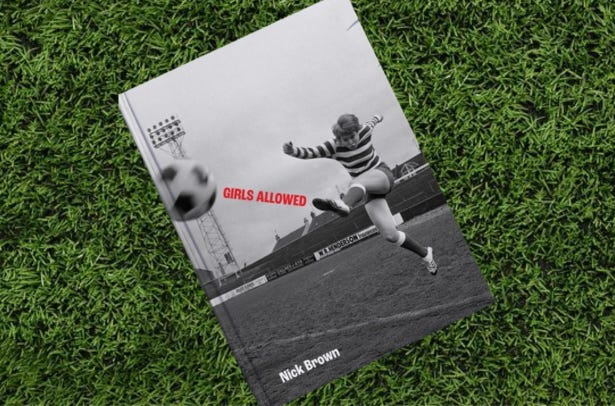
The following is an extract from the book Girls Allowed by Nick Brown and published by Halcyon Publishing. It is available for purchase here.
The first official women’s football game in Britain, played using Football Association rules, took place on 7 May 1881. It was staged at Hibernian Park, now the site of Easter Road, the home of Hibernian. How seriously was the game taken? Both sides, you assume, wanted to win, but perhaps — in the context of public perception — it is more telling to examine how the game actually came about.
Local theatrical agent Alec Gordon, along with colleagues Charles Scholes of Blackburn and George Imbert from London, put together teams to represent Scotland and England. Aside from drumming up a bit of publicity for the organisers and the chance for each of them to form new contacts, it is also possible that the match was put on merely as a money raiser, considering that Scholes’ theatre chain had collapsed the previous year. I’m not saying that was definitively the case of course, I’m sure the gentlemen involved were all for promoting the women’s game and getting it into the public’s subconscious ...
The players that day were not, of course, actual footballers. Theatre houses and ballet schools provided the participants. The game ended in a 3-0 victory for Scotland, Lily St Clair becoming the first official goal scorer in women’s football with the other two goals added by Louise Cole and Maud Rimeford. Considering the kits that we use today — shirts, shorts, socks and boots — it is a wonder that any of the players were actually able to move, let alone play a game of football in the outfits they were given. The Scottish team were attired in blue jerseys, white knickerbockers, red stockings, red belts and high-heeled boots. They also wore blue and white cowls.
On 9 May 1881, the Glasgow Herald reported on the match, stating that there was “a considerable amount of curiosity” and that “upwards of a thousand persons watched it”. The line-ups that day were, as reproduced in the Herald: Scotland: Ethel Hay (goalkeeper), Bella Osborne, Georgina Wright (backs); Rose Rayman, Isa Stevenson (half backs); Emma Wright, Louise Cole, Lily St Clair, Maud Rimeford, Carrie Balliol, Millie Brymner (forwards).
England: May Goodwin (goalkeeper); Mabel Hopewell, Maud Hopewell (backs); Maud Starling, Ada Everston (half backs); Geraldine Vintner, Mabel Vance, Eva Davenport, Minnie Hopewell, Kate Mellon, Nelly Sherwood (forwards).
A tour was arranged for these exhibition matches, with the return match being played the following week, on 16 May 1881.
This time the venue was Shawfield Ground, Glasgow, and things did not exactly go as planned. After nearly an hour’s play, with the score still 0-0, the game had to be abandoned. The reason? A report in the Nottinghamshire Guardian told the story:
“What will probably be the first and last exhibition of a female football match in Glasgow took place on Monday evening at Shawfield Grounds. Upwards of 5,000 spectators were present, and the absence of the fair sex was specially noticeable. The teams were supposed to be representative of England and Scotland, and as the Scotch team had won the recent match in Edinburgh, much excitement was thereby caused as to the result of the encounter.”
“The meagre training of the teams did not augur much for proficiency of play, and if the display of football tactics was a sorry description, it was only what might have been expected, and not much worse than some of the early efforts of our noted football clubs. The costume was suitable and at a distance the players could scarcely have been distinguished from those in ordinary football matches. The game was continued without interruption till the ends were changed but the chaff of the spectators was anything but complimentary. Cries of ‘go it Fanny’ and ‘well done Nelly’ resounded from all parts of the field, but the players went on the even tenor of their way regardless of interruptions. At last a few roughs broke into the enclosure, and as these were followed by hundreds soon after, the players were roughly jostled and had prematurely to take refuge in the omnibus which had conveyed them to the ground. Their troubles were not, however, yet ended for the crowd tore up the stakes and threw them at the departing vehicle, and but for the presence of the police, some bodily injury to the females might have occurred. The team of four grey horses was driven rapidly from the ground amid the jeers of the crowd and the players escaped with, let us hope, nothing worse than a serious fright.” It didn’t take long for crowd trouble to begin, did it?
You would have thought that that would have been the end of the ladies’ football matches, but no such thing. There is a saying that all publicity is good publicity — was that on the minds of the theatre impresario organisers? Despite the abandonment, they pressed on with their plans and headed south of the border. Just four days after being forced off and having makeshift weapons hurled at their getaway car, the players took to the field again — the show must go on, after all. This time it went on at the superbly named Hole-i’th-Wall Ground, the home of Blackburn Olympic. The match passed without incident and a 1-0 victory was had by the English.
The tour continued. Scotland secured a 2-1 win in Sheffield, there was a 1-1 draw in Liverpool followed by another Scottish victory, 3-2 in Bradford. All seemed to be going well until the touring party arrived in Manchester for a game at Cheetham Football Club on 20 June. The Manchester Evening News takes up the story:
“Last evening the female football players who, it will be remembered, were playing in Scotland a short while ago, put in an appearance on the ground of the Cheetham Football Club, Tetlow Fold, Great Cheetham Street. The time announced for commencement of proceedings was 7:30, but it was fully half an hour after that time before the players arrived on the ground. A large number of spectators were present, and although entrance money was charged the greater proportion of those in attendance managed to elude the vigilance of the gatekeepers. The match was announced as one between eleven of England and eleven of Scotland, and after some indifferent play, which lasted something like half an hour, the ring was broken into and the wildest confusion prevailed, with the players having to make good their escape.”
Another pitch invasion. At least there seemed not to have been too much violence this time.
Not to be deterred, the players returned to the ground the following evening to play the game. The next day, the Manchester Guardian printed the following report. I cannot help thinking by the opening remarks that the reporter was secretly amused, dare I say delighted, by the outcome:
“The score or so of young women who do not hesitate to gratify vulgar curiosity by taking part in what is termed a ‘ladies’ football match appeared last evening for the second time this week on the ground of the Cheetham Football Club, Tetlow Fold, Great Cheetham Street. The club however had nothing to do with the affair. The public had been invited by placard to witness a match between eleven of England and eleven of Scotland, the kick-off to take place at half past seven pm. The players, attired in a costume which is neither graceful nor very becoming, were driven to the ground in a waggonette and, as was to be expected, were followed by a crowd largely composed of youths eager to avail themselves of the opportunity presented for a little boisterous amusement.”
“Play — if kicking the ball about the field can be so described — was convinced pretty punctually. Very few persons paid for admission to the ground but a great multitude assembled in the road and struggled for a sight of what was going on within the enclosure, whilst an equally large number gathered on the higher ground on the other side of the field for a similar purpose. A number of police constables were present to maintain order and prevent anyone entering without paying, and for about an hour whilst this so-called match was being played, they succeeded. There were frequent attempts, however, to elude the constables. At length a great rush was made by those occupying the higher land and the football ground was speedily taken possession of by the mob.”
“Apprehending a repetition of the rough treatment they have met with in other parts of the country the women no sooner heard the clamour which accompanied the rush then they also took to the hills and ran to where their waggonette was standing. This they reached before the crowd could overtake them, and amid the jeers of the multitude and much disorder they were immediately driven away.”
About the Book: Girls Allowed traces the hard-won fight for women’s football in Britain, from dismissal and bans to its current status as the fastest-growing sport, while refusing to gloss over what remains unresolved. Celebratory yet cautionary, it highlights how progress in England contrasts sharply with Scotland, where only a handful of teams are fully professional and many players juggle jobs alongside football.
About the Author: Based in Cambridge, Nick Brown is the author of a number of football and travel books as well as and magazine articles. He has also presented sports programmes on local radio stations as well as being a football commentator.