


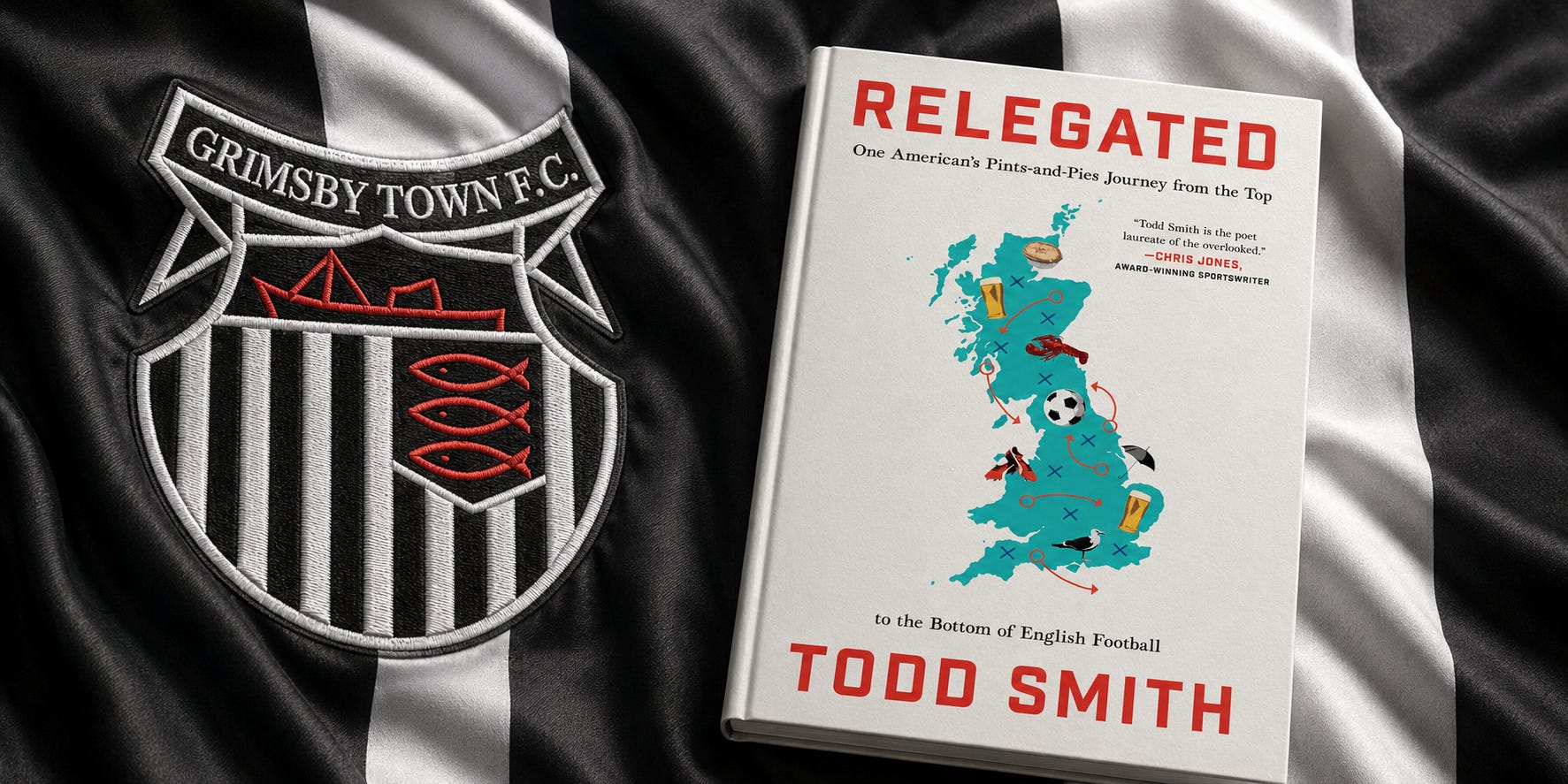
The following is an extract from the book Relegated by Todd Smith and published by Gallery Books. It is available for purchase here.
I’d chosen to come to Grimsby because I wanted to see football played in a place that had lost the other thing that defined it. Grimsby was once home port to the world’s largest fishing fleet. A 309-foot clock tower, a gift from Prince Albert, rose from the town docks as a beacon of strength and wealth. The Grimbarians, as they’re called, took immense pride in their successive generations of native sons who risked their lives in the dangerous North Sea to feed their nation. The threat of dying or being injured in their work was so real that when the sailors reached shore and got paid, they were known as “Three-Day Millionaires’’ because they blew all of their fortunes in epic runs of debauched gratitude. Once it became possible to preserve fresh fish in ice and transport it by rail, fish caught by Grimbarians in the morning would show up in London restaurants that night. It was the haul brought in by these men that helped usher in the craze for the country’s iconic dish, fish and chips.
Due to a myriad of factors—international fishing disputes, overfishing, labor shortages, bad government policies—the fishing industry and its jobs were eventually pulled clean out of Grimsby like the swift deboning of a northern Atlantic cod. By the 1980s, Grimsby suffered mass unemployment. The jobs never returned.
I was curious if that history would make the town’s football club a more important focus of its residents—a shared thing to rally around—or a secondary concern when there was so much else to worry about. Grimsby Town FC, est. 1878, were competitive through their first few decades, often beating teams fielded by much larger cities. From the start, they featured a trawler boat and fish on their team crest. Their peak moments came between 1929 and 1939, when they played the vast majority of their games in the top division of English football and made it to the semifinals of the FA Cup twice. After that, their performance was spotty. They became what’s known as a “yo-yo club,” swinging up and down through the different levels, in all switching divisions thirty-two times, with fifteen promotions and seventeen relegations. At the moment, they were in the fourth-tier League Two, with a real possibility of getting relegated again at the end of the season.
The day I arrived, Grimsby Town FC’s Under-18 team had an evening match. Youth clubs of this nature are known as academies—in American terms, it would be like a cross between an elite high school team and a farm team for a professional baseball club. I regrouped at my Airbnb after the grocery store and got ready for the game. First, I needed to pause in the vestibule of my flat while a man out on the street was having a psychotic event. I waited until there was a break in the yelling. Then I made it onto a bus, on which I rode with two women in tattered down coats who carried mop buckets with loaves of bread sticking out of them.
The bus dropped me off a few blocks away from Blundell Park, the stadium where the youth and senior teams both play. The legendary ground has been Grimsby Town FC’s home since 1898. As I walked, I could smell the sea. The stadium’s front gate rose out of the darkness like the Black Gate of Mordor from The Lord of the Rings. The walls were thick and metal and painted black and had spikes and barbed wire strung across the top in a lattice pattern.
Inside, things were far less intimidating. It was a proper old English ground, a relic to a humble and simpler time of football, and I absolutely loved it. There were no frills here, no modern amenities. Metal roofs hung low over three of the four sections. Wood beams and cheap plastic seats spoke to a bygone architecture and aesthetic. The bathrooms were fortresses seemingly built to survive the blitzkrieg. There was a pub underneath one of the stands. The walls were adorned with framed pictures of long-ago teams: the players in short shorts, long socks, and billowy blackand- white striped kits.
The U18 game I was there to see was meaningful to the town on two major counts. It was an FA Youth Cup match, and one against a higher-level opponent. Millwall FC played in the second-tier Championship division. The Grimsby boys had beaten the youth team of Premier League side Nottingham Forest to get here, and if they could pull off a second straight upset, it would be a big deal. However, the mood before the match was not at all celebratory, and for good reason. Grimsby Town U18 were playing their first game since the tragic deaths of their popular defender Cameron Walsh and his father, Dave, in a car accident.
The team warmed up in white T-shirts adorned with Cameron’s face. The crowd of supporters around me watched while talking low and taking long, contemplative pulls from their tea and coffee and pints. The stands were nearly full—impressive, I thought, for a Wednesday night in horrid weather. Sheets of mist blew in off the Humber Estuary a quarter of a mile away. Perhaps football was helping to bring a struggling fan base in mourning together. I stood along the field and watched warm-ups from a sideline railing.
An older man with a round face, chappy hat, and bulbous nose was next to me. He looked something like the cartoon mascot from the Andy Capp’s Hot Fries packaging. We nodded hello to each other.
“Terrible thing that happened to that young lad. ’Tis just terrible,” he said.
“Yes, tragic,” I agreed.
“Say, where you from, then?”
“I’m Todd from America.”
“Bob,” he said, shaking my hand. “What state are you from, then?”
“Minnesota.”
“Is that a Trump state, then?”
This question came up all the time. After learning that I was American, almost everyone I met wanted to know if I was from a Trump-supporting state or not. I would find myself wondering which answer they were hoping for, and tried to avoid politics as best as I could. The people of Grimsby had decidedly voted for Brexit and supported Boris Johnson—the conservative politician often compared to Trump—for prime minister. Johnson had even been photographed multiple times in a Grimsby Town FC hat. I told Bob that Minnesota was a purple state, explaining what that meant and flailing for an off-ramp joke about Prince. It was good enough to get us to move on.
After some small talk about American television shows and the Grimsby Town FC senior team and the purpose of my trip, I asked Bob the question most on my mind. “Did you know the young player who died? Or know his dad?”
“I didn’t know them. But I’m a Grimer,” Bob said. He paused for a long while, and I tried to give him space. It seemed like he was searching for the right thing to say. “I used to come here,” he continued. His words were uneasy and tottering, like the steps of a baby deer learning how to walk. He took a breath. Then he said, “I used to come here. I used to come to every Town game, home and away. I did that for a long time. I did that for far too long.”
I looked over at Bob. He stared straight ahead at the field, but I could see tears welling up that were too stubborn to fall. I didn’t quite know what to do. The heaviness of the night was so palpable there between us. The crowd behind us swayed and swelled as kickoff approached. I stayed still.
“I used to come here,” he repeated. “I used to go to every Town home and away match. I was going to all the matches and carrying on in the pubs. Things, you know, mate, went that way for too long. I tried to get better. But I couldn’t stop. I tried to get on with it. It was so hard to quit. I had to stop coming here. To get better.”
Because of my Crohn’s disease and migraines, I stopped drinking more than twenty years ago. Before that, I was a social drinker, not a very heavy one. In the time since, I’ve only had about four drinks, and all of them had been in the last four weeks. But I’ve known many alcoholics and addicts in my life. I’ve worked with them on blue collar jobs and counted them among my friends and family. I’ve been there in moments when life triggers something deep inside them and it unexpectedly rises to the surface. I told Bob: “Well, I’m glad you came tonight.”
Excerpted from RELEGATED: One American's Pints-and-Pies Journey from the Top to the Bottom of English Football by TODD SMITH. Copyright © 2026 by TODD SMITH. Reprinted by permission of GALLERY BOOKS, an imprint of Simon & Schuster, LLC.
About the Book Relegated: One American’s Pints-and-Pies Journey from the Top to the Bottom of English Football is part travel memoir, part exploration of football culture. Framed around the uniquely British concept of relegation, Todd Smith embarks on a months-long journey across England, Scotland, Wales, and Northern Ireland, visiting clubs at every level of the football pyramid, from the glamour of the Premier League to forgotten non-league grounds. Along the way he discovers that football is about far more than trophies and television deals. Through conversations with supporters, pub owners, volunteers, players, and local characters, Smith uncovers how clubs act as repositories of community identity, collective memory, and belonging.
About the Author: Todd Smith is an American writer based in Minneapolis whose work spans sports, memoir, and journalism. The son of the head athletic trainer of the former Minnesota Kicks, Smith grew up immersed in football and played the game himself through college. Before publishing Relegated, he spent many years working blue-collar jobs while pursuing a writing career, an experience that informs much of the book’s personal narrative. He is also the author of Hockey Strong: Stories of Sacrifice from Inside the NHL and co-author of Brave Enough with Olympic champion Jessie Diggins. His writing has appeared in a range of magazines and sports publications, and Relegated reflects both his lifelong love of football and his fascination with the communities that sustain it.
Just added it to the queue. Great excerpt. Excited to give the full book a read.
How could you not want to read more after this? Great stuff will def get this ordered.