


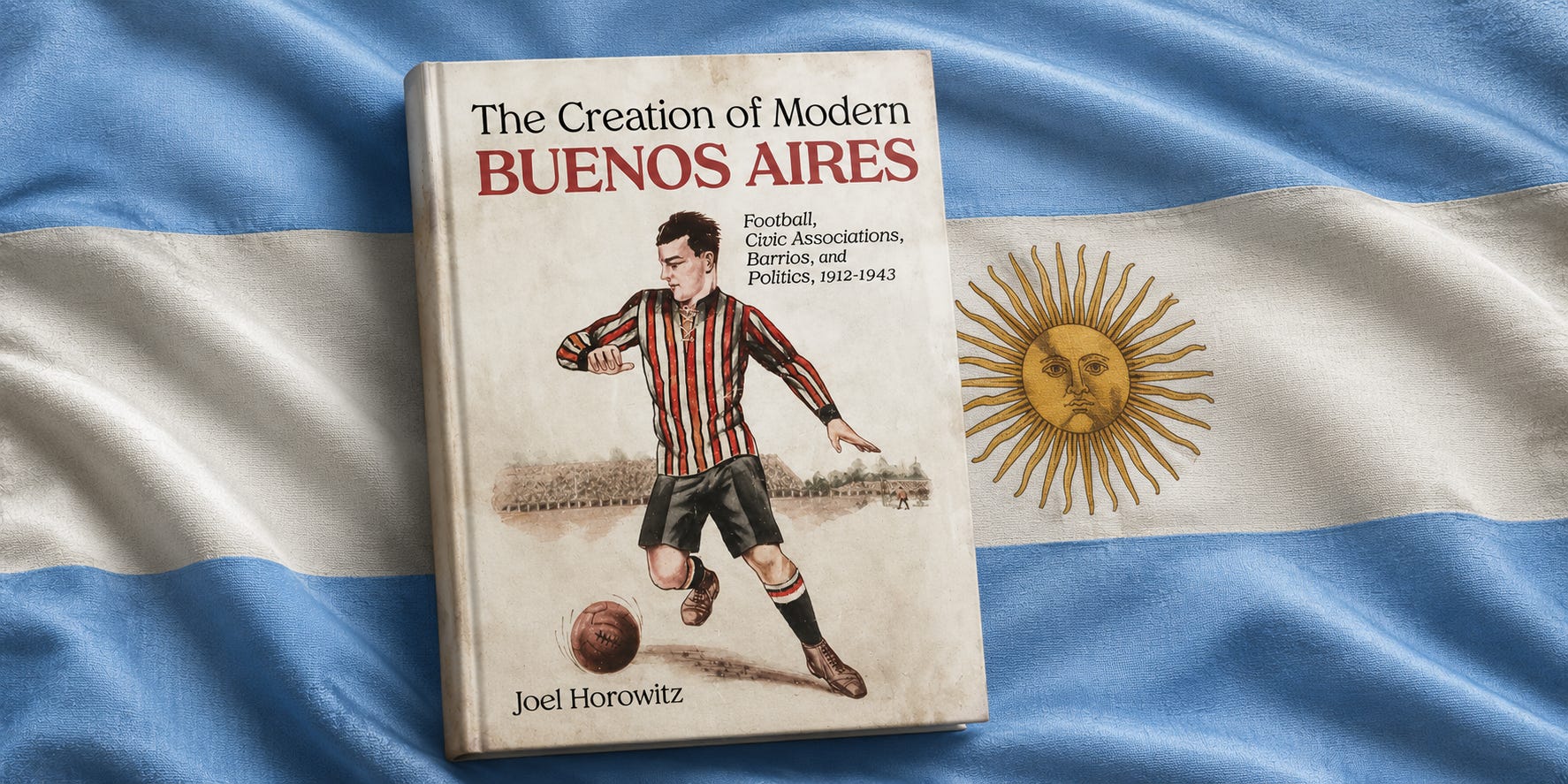
The following is an extract from the book The Creation of Modern Buenos Aires by Joel Horowitz and published by University of New Mexico Press. It is available for purchase here.
A Suburb and the Role of its Key Football Clubs
In Avellaneda [an industrial suburb of the city of Buenos Aires], two clubs—Racing and Independiente—embedded themselves, becoming two of the largest and most popular clubs in the country. [Soccer clubs were civic associations whose members elected the club leaders]. They became centers of sociability for members and sometimes for other local inhabitants, offering athletic and cultural activities and educational opportunities. The two clubs developed into fierce rivals on the playing field, and they also came to represent opposing political positions.
From its inception, Racing was tightly tied to the Conservative political boss Alberto Barceló, who dominated Avellaneda during almost the entire interwar period. Therefore, Racing was usually run by men connected to the local Conservative political elite. Barceló’s initial support for Racing came when football had not yet become important and before the voting reform of 1912, and therefore he was not looking for popular support. Barceló carried out a more traditional type of patronage, aiding his friends and relatives in something they wanted to do.
Racing’s initial supporters came from Avellaneda’s middle class. One direct predecessor was created by Argentine employees of the Ferrocarril Sud while another was formed after a meeting at the home of two of Barceló’s brothers. A member of that club, Alberto’s brother-in-law Leandro Boloque, later would lead Racing for three years.
After several twists and turns, in 1903 Racing was founded by Argentine males who were mostly under twenty. By January 1909, the club had 251 members and received economic assistance from the Barceló family. Opposition to the Barcelós caused some founding members to leave Racing and play for Independiente. Independiente had just moved to Avellaneda, and it became identified with Barceló’s opponents. Racing’s connection to Barceló had many other consequences. For example, in 1915 and 1916 the opposition paper in Avellaneda claimed that the local police favored fans of Racing over those of Independiente. In 1917, after President Yrigoyen intervened in the province of Buenos Aires, replacing a Conservative governor and charging a Radical with organizing new elections, at least three Racing players lost their city employment.
Racing dominated Argentine football from 1913 to 1919, and according to some, its manner of play began the start of a distinctive Argentine style. In 1920 Racing was the largest club in the country with 1,413 members. As it grew, Racing increasingly became a center for many types of activities, which increased its attractiveness. At the beginning of the 1920s members could participate in basketball, swimming, track, and Basque paddle ball. In 1926 Racing had 2,624 members, making it the third largest club—just ahead of Independiente. By 1931 it claimed slightly over 7,000 members, while Independiente had over 5,000. In 1935 Racing had 21,500 members, and its rival had 14,500. In 1941 the former claimed 17,053 members and the latter 17,454. Racing had continued to add sports. By the end of 1935, members enjoyed football, tennis, bocce, basketball, paddle ball, roller skating, field hockey, track, gymnastics, swimming, ping-pong, fencing, and Greco-Roman wrestling. Some sports were played by both men and women.

Racing also celebrated carnival; for example, in 1936 it scheduled six dances, each with two bands, one that played tango and one that played jazz. The club also held dances at other times, frequently with the same musical lineup. It established a beach for its members along the coast. For its young members it had a summer camp, offered excursions, and created a chorus and a theater. During the summer, Racing showed free movies, which nonmembers could attend. The club offered lectures by diverse speakers, including the Communist militant and historian Rodolfo Puiggrós, the educator Pablo Pizzurno, the physician and Socialist Alicia Moreau de Justo, and the Radical Party politician and historian Emilio Ravignani. It hung art in its facility and sponsored concerts of works by famous composers. The club organized classes, including cooking instruction by Petrona de Gandulfo (known as doña Petrona), the author of Argentina’s iconic cookbook. Racing also organized a football tournament in 1933 in which twenty-eight schools participated. It gave milk to 500 children three times a week. In other words, it was part of the community and a critical center of sociability.
Barceló’s influence over the club was extremely large. According to Juan Corradi, Barceló discussed Racing’s affairs with club leaders at his home. The club’s political connections are revealed by the indictment in 1916 of Barceló and several followers for using their official positions to influence elections. Three of the accused, Leopoldo Siri, Luis Carbone, and Pedro Groppo, had been or would be presidents of Racing; together, they held that post for thirteen years. All were absolved. In a study of the twenty-eight most influential followers of Barceló, ten belonged to Racing and one to Independiente. However, elections were often contested, and the close allies of Barceló were not always victorious.
…
Independiente gave its members and the community many of the same opportunities that Racing offered, though on a slightly smaller scale, but it was still a significant club. For example, in 1928 it inaugurated with the presence of the Radical governor of the province the first cement stadium in South America, which sat 60,000. Although its members could enjoy a variety of sports, the opportunities were fewer than those at Racing. Fewer cultural opportunities existed as well. However, it too was a center of sociability. Independiente sponsored lectures and classes of music, singing, and various needle-working skills. It hosted carnival celebrations and dances that paralleled its rival. Club members also created a theater company. In early 1936 Independiente opened a site for camping at a beach in the nearby community of Quilmes. The club also involved itself in the community and helped provide physical education for local schools. In 1935 it gave a year’s pass to its field to the two best students in each local school, and it held a celebration for the graduates of local elementary schools. When Independiente, as part of its expansion into the capital, purchased a preexisting facility, members could participate in dances and several sports there.

The larger scope of Racing is not surprising in a city dominated by Barceló, and to a large extent his opponents ran Independiente. Its first dominant figure was Juan R. Mignaburu, a lawyer, who had been intendente of what became Avellaneda in 1899 and served on the city council in 1902. In 1894 he had founded a newspaper that defended the political positions of Bartolomé Mitre (an opponent of the Conservatives). Mignaburu served as president of the club in 1911–1912, 1917–1918, and 1920–1921 and was active in the club for many other years. His successor as the dominant figure was Pedro Canaveri, a Radical who was president in 1919 and from 1922 through 1933 and from 1942 to 1945. During two of those years, he served on the city council of Avellaneda. Miguel Martinicorena, who was club president from 1938 to 1941, was also a Radical Party militant.
…
The two clubs created deep loyalty in Avellaneda, and even funeral homes got involved. Two funeral homes existed in the city: one owned by the Peruihl family, who were fans of Independiente, while the other was owned by the Corradi family, who supported Racing and not incidentally Barceló. When the two teams played, the victor’s followers would go to “their” funeral parlor, borrow coffins, and parade them past their opponents.
About the Book: The Creation of Modern Buenos Aires by Joel Horowitz examines how Argentina’s capital evolved into a modern metropolis during the late nineteenth and early twentieth centuries. Through politics, immigration, urban development, social movements, and everyday life, Horowitz explores the forces that shaped Buenos Aires and the identities of the people who lived there. The book offers a rich portrait of a city in transformation and provides valuable insight into the social and political environment from which many of Argentina’s most important institutions, including its football clubs, emerged.
About the Author: Joel Horowitz is a historian specialising in modern Argentine history. His work focuses on the political, social, and cultural forces that shaped Argentina during the nineteenth and twentieth centuries. Through extensive archival research and a strong emphasis on the experiences of ordinary citizens, Horowitz has established himself as one of the leading scholars examining the development of modern Buenos Aires and Argentine society.