


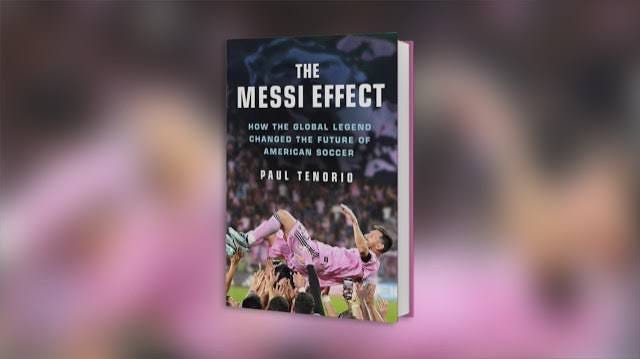
The following is an extract from the book The Messi Effect: How the Global Legend Changed the Future of American Soccer by Paul Tenorio. It is available for purchase here. Copyright © 2026 by the author, and reprinted with permission of St. Martin’s Publishing Group.
The lasting impact of the buzz around Lionel Messi in MLS was already being put to the test after the league’s three-month offseason.
Going into the 2024 season, Messi’s presence in Miami wasn’t dominating new cycles as it had the previous summer, but it was still generating lucrative opportunities. Inter Miami was intent on cashing in. It scheduled a three-week preseason tour on which Inter Miami would cover more than twenty thousand miles and circumnavigate the globe—to El Salvador and Dallas, to Saudi Arabia and Hong Kong, and to Japan and back to Fort Lauderdale.
Now, some 7,500 miles away from home, stark realities for MLS, Inter Miami, and Messi were setting in. It was February 1, 2024, and the final whistle had just sounded on Inter Miami’s second game in Saudi Arabia, a 6–0 drubbing by Al Nassr.
A shirtless Messi stepped into the middle of a silent postgame locker room at the Kingdom Arena in Riyadh and looked around at his teammates.
“Guys,” Messi started, the emotion in his voice rising. “We can’t play like that. We can’t not compete. It’s unacceptable.” Six days into the junket’s Asian leg, frustrations were boiling over.
One player, a bright young winger named Facundo Farias, was lost for the season with a torn anterior cruciate ligament (ACL) suffered during the opener in El Salvador two weeks prior. Players hardly felt like getting on a plane to travel across the world for meaningless friendly games, even less after the biggest draw of the tour—one final meeting between rivals Cristiano Ronaldo and Messi in an Al Nassr versus Inter Miami showdown, billed as “One Last Dance” was off the table. Ronaldo was injured and wasn’t going to appear in the friendly.
“When Ronaldo got hurt, it was just like, why are we even going now?” Inter Miami defender Noah Allen recalled.
Miami lost its first game to Al Hilal 4–3 in an entertaining if error-filled contest three days earlier in Saudi Arabia. Messi, who played eighty-eight minutes in that loss, approached the second exhibition in Riyadh dealing with muscle fatigue. Inter Miami initially published a team sheet absent its star’s name, only for the Argentine to emerge for warm-ups wearing cleats and a jersey, much to the crowd’s delight. The club deleted its first post and released a new graphic featuring Messi’s name on the list of substitutes.
From the street, the Kingdom Arena looked a bit like a giant Neiman Marcus at an American shopping mall. Built in just 180 days, in part to host these games, the stadium included a high wall of suites looming over one sideline and fans stacked around the other three. The vertical design lent a gladiator style feel to the arena. A block away, the Riyadh Season festival was in full bloom: A Ferris wheel shined in purple neon, a roller coaster rumbled past every other minute, and a mini-Vegas– like sphere lit up the skyline. It was yet another facet of the show the Saudi league was putting on for the world.
Inter Miami was the first guest at the Kingdom Arena, and it had not gone well for the American side.
For eighty-three minutes, Messi watched as Al Nassr ran through his team. The Saudi side led 3–0 at halftime. The rest of Miami’s Big Four spent more time throwing their arms in the air in frustration than creating anything with the ball at their feet. Al Nassr added another three goals in the second half.
After every tally, the stadium’s video board cut to a split screen. The eternal rivals weren’t sharing the field, but they remained the center of conversation. On one side, Messi leaned back in his seat on the bench; on the other, Ronaldo’s Cheshire-cat grin told the whole story. The crowd roared with its approval each time. And each time, Messi seemed to recline farther, making it a bit harder for the cameras to get a good angle.
Miami’s star No. 10 played the last seven minutes, fulfilling a contractual obligation. His cameo added additional insult to the lopsided affair. Messi’s name was now in the box score of a 6–0 defeat.
When Inter Miami returned to its locker room, a frustrated Messi walked into the center of the space. Then he started to speak. For nearly three minutes, he excoriated the group. His teammates had treated the match too much like the meaningless friendly it actually was. But Messi knew the result would be reported as anything but that.
“We should want to play these games,” Messi seethed to the defeated locker room. “If you guys don’t wake up, we’ll go home now.”
As he entered his twentieth season as a professional, Messi had long ago learned that every appearance on the field was an assessment, validation, or challenge to his legacy. That scrutiny extended to the club and league he represented. So, yes, the players’ frustrations about the tour were valid. Yes, they were four games into the preseason and playing an opponent in midseason form. Yes, jumping through time zones on a globe-trotting odyssey was far from an ideal way to prepare for the MLS campaign. And yes, the Saudi clubs had a distinct economic and thus quality advantage over Miami, even with its household names. But none of that mattered.
To Messi, the ninety minutes that had just unfolded lacked any sort of understanding by his teammates that Inter Miami represented something bigger now. He was right. Around the world, this wasn’t a preseason game. It was taken as an assessment of MLS. Inter Miami didn’t have the luxury of an off night or the leeway to shake off its preseason rust. Not if it was going to be Messi’s team. There was an obligation to meet a certain standard, to always want to win every game.
Always.
He ended the verbal lashing with a message: “From here on out, we’re going to win everything.”
There were ten months left in the 2024 season. Winning everything was an impossible mandate, but it was the standard Messi had long imposed—on himself as much as on the teams around him. Anything but striving to be the best was unacceptable, but that didn’t fit within the structure of MLS. Messi didn’t care.
Inter Miami assistant coach Javier Morales stood next to Messi, tasked with translating his words for the team’s English speakers. The forty-four-year-old Argentine and former MLS star felt blessed to be on the staff coaching Messi. He had friends getting their UEFA or U.S. Soccer Pro coaching licenses. None of them was getting near the education he was by working with the greatest to ever play the game.
“What I’m learning from this,” Morales said, “is a treasure for me.”
He discovered, though, that translating for a legend wasn’t an easy task. It wasn’t just about finding the right words. There was pressure to accurately capture the emotion.
“But in this case it was easy,” Morales recalled. “Because he was talking from his heart.
“From my point of view, he is a person that is insatiable. He is never gonna get full of winning or titles, because that is in the way that he lives his life. He doesn’t recognize a difference between a La Liga or MLS title. Of course, he understands the difference, right? But he wants to win. It doesn’t matter where he is.
“We’re talking about a player that has won the World Cup and won more titles than anyone in the world. He wants to win. If he is playing a small-sided game in training and he doesn’t win, he’s pissed. Or if he loses playing cards, or two-touch or whatever. He always wants to win.
“It’s the thing that feeds him. But at the same time he is never going to get full.”
While Messi fumed about the performance against Al Nassr—a result Inter Miami’s own coach had seen coming—MLS buried the score on its website and moved on. An event that had been given top billing all day and then aired live on Apple TV’s MLS Season Pass app suddenly had no meaningful presence beyond a meager 135-word recap on the site.
It betrayed the same lack of understanding that set Messi off in the locker room.
MLS was reverting to habit: showcasing the league’s positives while ignoring or burying the flaws. But there could be no putting your head in the sand when the greatest player in the history of the game was involved. The spotlight was simply too big.
“Al-Nassr humiliate Messi’s Inter Miami as Cristiano Ronaldo watches from stands,” blared The Guardian’s headline. The Miami Herald called it a “Nightmare in Saudi Arabia.”
As Messi’s second MLS season started, the losses in Riyadh revealed cracks in a partnership that initially felt like a perfect fit. Messi had won everything. He had nothing left to prove. But he was still prepared to compete and strive to be the best. He knew no other way.
Meanwhile, MLS, a league with so much still to prove, remained noncommittal about how it might match and leverage the ambition that Messi in Miami represented.
Copyright © 2026 by the author, and reprinted with permission of St. Martin’s Publishing Group.
About the Book: The Messi Effect: How the Global Legend Changed the Future of American Soccer, published by St. Martin’s Press in June 2026, explores how Lionel Messi’s arrival at Inter Miami in 2023 transformed not only a struggling football club but the wider landscape of American soccer.
Drawing on extensive reporting and access to key figures within Inter Miami and Major League Soccer, Paul Tenorio takes readers behind the scenes of one of football’s most consequential transfers. From the commercial explosion surrounding Messi’s arrival to the decisions made in MLS boardrooms, the book examines how a single player became a catalyst for extraordinary growth, while raising questions about whether American soccer could fully capitalise on the opportunity.
Part sporting narrative, part examination of the business of football, The Messi Effect considers the extraordinary influence of a global superstar and what his final playing years might mean for the future of the game in the United States.
About the Author: Paul Tenorio is a senior writer at The Athletic, specialising in American and international football. He has covered the sport since 2007, establishing himself as a respected journalist with particular expertise in Major League Soccer, its development and the business behind the game.
His reporting has also appeared in The Washington Post, ESPN, FourFourTwo and the Orlando Sentinel. A Costa Rican American who grew up in Mount Vernon, Virginia, Tenorio graduated from Northwestern University’s Medill School of Journalism. The Messi Effect is his first book.