


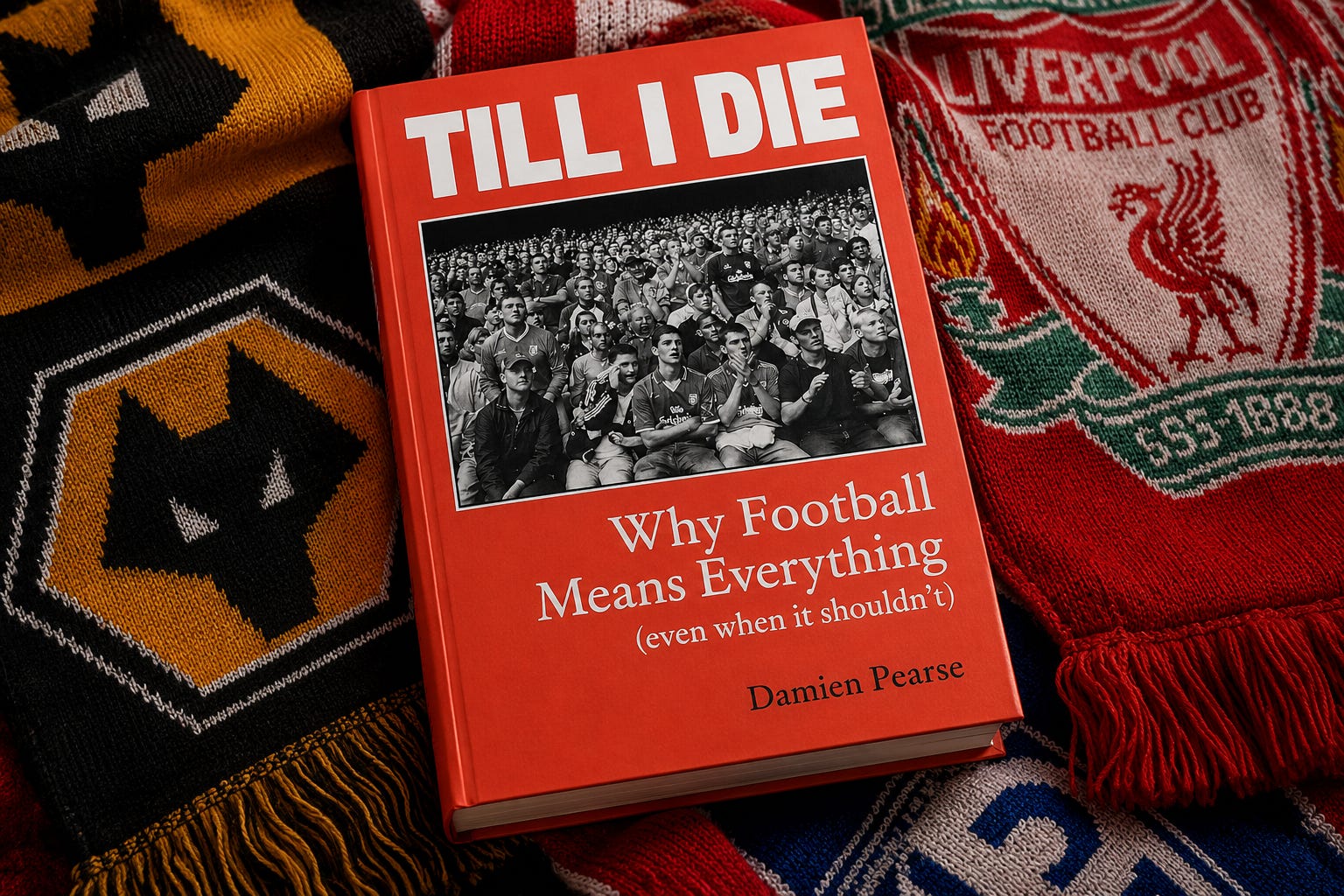
The following is an extract from the book Till I Die: Why Football Means Everything (Even When It Shouldn’t) by Damien Pearse and published by Oneworld Publications. It is available for purchase here.
I’m on a dog walk in February and feeling the impact of another Wolves loss on my mood.
It’s my usual circuit from a Saxon church, about 5 miles from Hastings; through the cemetery, past the pond, across open fields and looping back through woods where bluebells would soon stage their slow-motion resurrection.
It is one of those crisp, cloudless winter days when the blackbirds return, convincing you that spring might have arrived early. But my mind notices nothing of the beauty around me. As I crunch along the cemetery path, the dog jumps up for the ball, leaving a paw print on my jeans.
‘I haven’t got the fucking ball,’ I snap. ‘I left it in the car.’ He does it again. I’m easily irritated.
Before I get to the meadow, I sit down on a bench in the graveyard under a small oak tree. I fail to register why it’s there because my head is busy wrestling with an idea.
The emotional turbulence of being a football fan had been going on for years now, decades even, giving me moments of euphoria, but also ruining countless weekends. Not just for me, but for those around me too.
It was hard to justify, really.
Of course, I could understand why I might feel a little disappointed if Wolves lost or pleased if they won, but the profundity of my mood swings were disproportionate for an adult.
I didn’t even live in Wolverhampton anymore and these were a bunch of young men who wouldn’t recognise me if I walked into the home dressing room with their names tattooed on my forehead.
Why does a win feel like I’ve popped an ecstasy tablet, and a loss like I’ve been hurled into an emotional pit with no exit ramp? Where does all this rage come from?
And why am I compelled to watch games week after week, even when I know that the likelihood of feeling better at the end is low?
Sitting on the bench, I started to wonder if I could use some of the skills I had picked up over the course of my career to unravel this mess.
I have been a journalist for many news organisations, including the Wolverhampton Express & Star, the Press Association, the Guardian and Sky News. I have even dabbled in sports reporting and followed England football hooligans during international tournaments.
Over the last 15 years, I have learned to unpick the messy knots of the human mind as a therapist, working in the NHS and now privately as a trauma specialist.
What if I used these skills to address the question: Why does football matter so much?
Behind me, a blackbird starts up again, as optimistic as a pre-season football fan. The dog drops something indistinguishable and damp at my feet and looks up, expectant. I ignore him.
Where do I begin with this project?
I already had some data from the Liverpool game, where I’d made notes tracking what felt like a disturbing experience. In fact, I’d already sketched the bones of what would become the introduction to this book. But before disappearing into a 90,000-word exercise in navel-gazing, I needed to know if I was a bit of an outlier, a fringe lunatic, languishing in my away kit, many football pitches away from the normal distribution.
Or was this affliction – this compulsive, all-consuming emotional chaos – something lots of other people were suffering with as well?
I don’t think asking a few mates on WhatsApp will cut it. At best, that’s a biased sample, fewer than twenty men, all from the same Catholic state school in Wolverhampton, emotionally stunted in strikingly similar ways.
So I decide to go wider and test my premise on the Facebook group where I’d recently been complicit in Gary O’Neil’s humiliation. That might give me some proper data.
I write: ‘Hi, everyone. I’m writing a book about the madness of being a football fan, from the perspective of a psychologist. I want to answer questions like “Why does this game make me so dysregulated?” I want to check I’m not some weird, maladjusted oddball. I want to explore the emotions and behaviours other fans experience. What bemuses you about being a fan?’
Then I brace myself, genuinely uncertain of what I’ll get back.
These forums can get toxic very quickly. I am expecting abuse, some unpleasant trolling at the very least. The child in me covers his face and prepares for digital annihilation.
I wait.
I set off into the meadow, the low sun spilling over the wood ahead. I am glued to my phone, neck in a U-bend, arms tense, breathing shallowly. Will I be ignored? Laughed at? Maybe I’ll be reported to the group’s admin for misusing the forum.
Five minutes pass. Nothing.
I jab at my phone, refreshing the page with the frantic concentration of someone typing at high speed with one finger. The familiar weight of shame begins to stir in my stomach. I reach the edge of the woods feeling anxious.
I loop back towards the church, barely registering the snowdrops and daffodils jostling for space beneath the naked trees. Glancing up from my phone, I spot a group of walkers heading towards me, clutching poles, chatting, laughing, entirely at home in the landscape.
I suddenly feel self-conscious.
As they pass, I tuck the phone into my pocket and offer a hearty, countryside grin. I make some wholesome remark about the promise of spring.
They nod. And as soon as they are safely out of range, I pull the phone out again.
Still nothing. I begin to suspect I really am an outlier.
By the time I reach the cemetery, there are signs of life. A few likes. Then an actual response. And then the dam breaks.
Dozens of replies. Then hundreds.
There was despair, conspiracy theories, hatred of officials, unbridled joy, arrogance, pure, unfiltered rage, schadenfreude, relationship stress. The data was pouring in.
Then, something stranger happens. Private messages begin to arrive with friend requests. My phone is pinging constantly. People wanted to confess.
There were fans who said that they loved football as much as their children and partners. There were some who had planned weddings around fixture lists and skipped funerals for cup ties. There were those that had grieved the transfer of a player they’d never met but somehow loved.
One woman messaged me in desperation: ‘I’m so sorry I have hacked this group but we’re on the verge of divorce. He’s obsessed. It’s like I don’t exist.’
She gave an intimate account of their physical disconnection, finishing with a single, aching question:
‘Can you help me understand?’
Some wanted to meet me in person.
Others asked for professional help, as if, as a mental health professional, I held the antidote to whatever this unnamed affliction was.
And then there was John, who describes himself as an ex-hooligan. He tells me he’s moved his season ticket to the quieter upper tier of one of the stands not for the view, but to protect himself.
‘VAR, and the incompetent refereeing has me back in the red mist zone. Only the fact I’m high up stops me from doing something mad.’
I stare at my phone, amazed at how honest and open people are being.
Friends call me when they are in crisis. Some, especially my patients, might go so far as to describe me as calm. Yet football seemed to bypass all of that maturity and wisdom. It distorted my personality, as if I was being hijacked by a younger, more volatile version of myself.
Like John, I was unsettled by my inability to control it.
By the time I reach the church, I have 197 direct messages.
I sit down on the bench in the cemetery and try to take it in.
I click on a message from Andrew, a Wolves fan who’d moved to Detroit at twenty-six. He describes his fandom as an addiction.
‘It’s Friday evening. I’ve just eaten and should be relaxing, but I’m already feeling anxious about tomorrow’s game.’
He tells me how the recent sending-off of Matheus Cunha has knocked him sideways.
‘Honestly, I was quite distraught. Waves and waves of emotion and I didn’t know what to do with it.’
Then Andrew mentions something that would become central to the book: connection.
‘The Michigan Wolves supporters’ group. We meet at an Irish pub in Plymouth, Michigan. It helps. To share it.’
He tells me his mum has just died. He reassures me he has a therapist and is coping, but it feels good, nevertheless, to tell me.
Down the gravel path, I spot two girls, maybe twelve or thirteen, walking slowly. They approach a grave and lay down bottles of Prime. One begins to cry.
The grave is covered in football memorabilia: youth trophies, medals, footballs, a Manchester United teddy bear, colourful stones and pictures.
The grave belongs to Harry Dennis. He died at eleven years old.
Football, it seemed, had already been a defining part of who he was.
I didn’t know it then, but his mum would later help me understand something important about the irrational, fragile beauty of being a fan. And she would remind me about how football has immense power for good.
Making my way back to the car, my phone was still pinging.
About the Book: Till I Die: Why Football Means Everything (Even When It Shouldn’t) is an exploration of football fandom and the extraordinary hold it can have over our lives. Blending psychology, reportage, and personal reflection, Dr Damien Pearse examines why supporters invest so much of themselves in clubs that can so often leave them frustrated, heartbroken, or euphoric. Through conversations with fans, scientists, players, and online provocateurs, the book explores identity, belonging, masculinity, obsession, and the emotional extremes that football can provoke. Rather than focusing on the game itself, Till I Die seeks to understand the people who live and breathe it.
About the Author: Dr. Damien Pearse is a chartered psychologist specialising in trauma. Before entering psychology, he worked as a journalist, becoming one of the youngest specialist reporters at the Press Association, where he covered football hooliganism during the 1998 FIFA World Cup and UEFA Euro 2000. He later worked for both The Guardian and Sky News. A lifelong supporter of Wolverhampton Wanderers F.C., Pearse combines professional expertise with personal experience to examine the psychological and social forces that make football such a powerful part of people’s lives.
Re the title ‘Till I Die’, I often felt, as a Spurs fan, particularly over the last two or three seasons, that they were working hard to bring that end point forward by a good few years.