


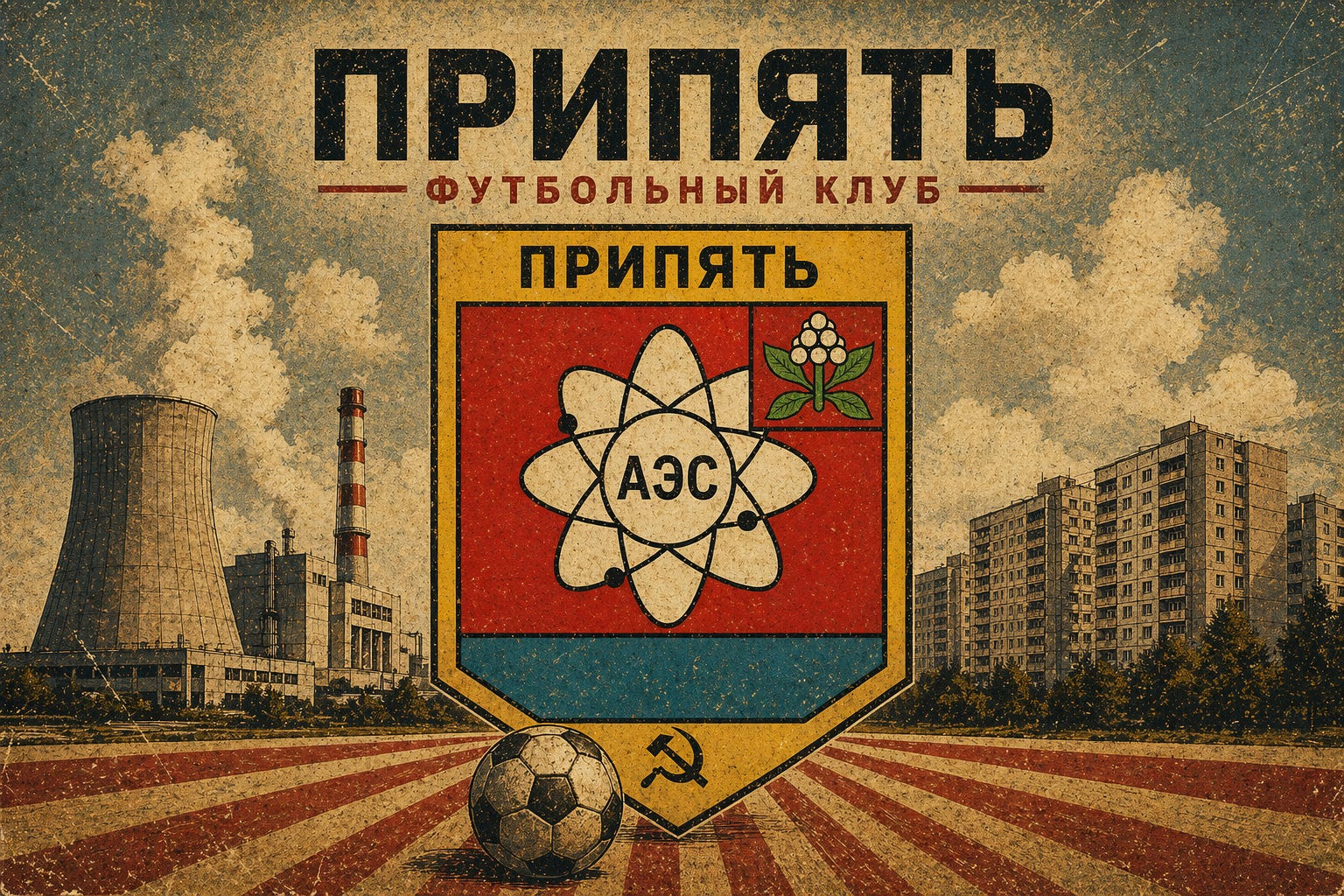
On the face of it, there was nothing especially unusual about FC Stroitel Pripyat. It was a club that grew alongside the community it served, and in time, disappeared with it. For all of its existence, it played in a modest stadium, competing in regional leagues far removed where the real glory lay. There were no great triumphs or trophies that demanded remembrance. There weren’t even any players who carried its name far beyond its immediate surroundings.
None of which is surprising.
Stroitel Pripyat was not built to be exceptional. It existed as so many clubs did across the Soviet Union: as a social fixture aimed at providing a healthy outlet for the families of that community. Results were not important, even if there was some ambition, but this was more about familiar faces gathering in a communal place and help build community in a manner only football can.
The name itself told you much that you needed to know about the club itself. Stroitel means “builder” and the club was named, as so many others, after the industry that gave the town its reason to exist. There was Shakhtar for the miners, Metalurh for the steelworkers, Spartak for the sporting societies of the urban intelligentsia. And here was Stroitel for the men who had raised Pripyat out of the marshland, who had laid its pavements and fitted its windows and poured the concrete of a reactor that was supposed to light up the future.
The club was a mirror of the city, and the city was, in the Soviet imagination, a model of what nuclear progress could look like.
Still, Pripyat was unlike most places in the Ukrainian SSR. Founded in early 1970 to house the workforce of the Chernobyl Nuclear Power Plant, it was a young city in every sense. The average age of its residents hovered somewhere in the mid-twenties. There were parks and swimming pools and a fairground. The shops, unusually for the Soviet periphery, were well-stocked goods that would require a trip to Moscow elsewhere were available here as a matter of course.
It was a city designed to demonstrate that the Soviet system could provide.
Football arrived as part of the same logic. The workers were young and needed somewhere to put their energy; the families needed reasons to gather. The club was initially just a town team, informally organised but grew out of this necessity in the mid-1970s, drawing many of its earliest players from the surrounding villages.
In time, as the city’s ambitions grew, so did the club’s. Players were brought in from Kyiv and Dnipro and other cities, given work at the plant, albeit not especially demanding work, in exchange for turning out at weekends.
A former Soviet international, Anatoliy Shepel, who had played for Dynamo Kyiv and Chornomorets Odessa, took charge as coach in the early 1980s. The club entered the KFK Championship, a Soviet-wide amateur competition that sat just below the professional pyramid, and began to take itself a little more seriously.
The best of it came in three consecutive years. Between 1981 and 1983, Stroitel won the Kyiv Oblast championship each time, a run of regional dominance that suggested that the club could be something more than it was. There were people in the city who believed, not unreasonably, that a professional future was within reach.
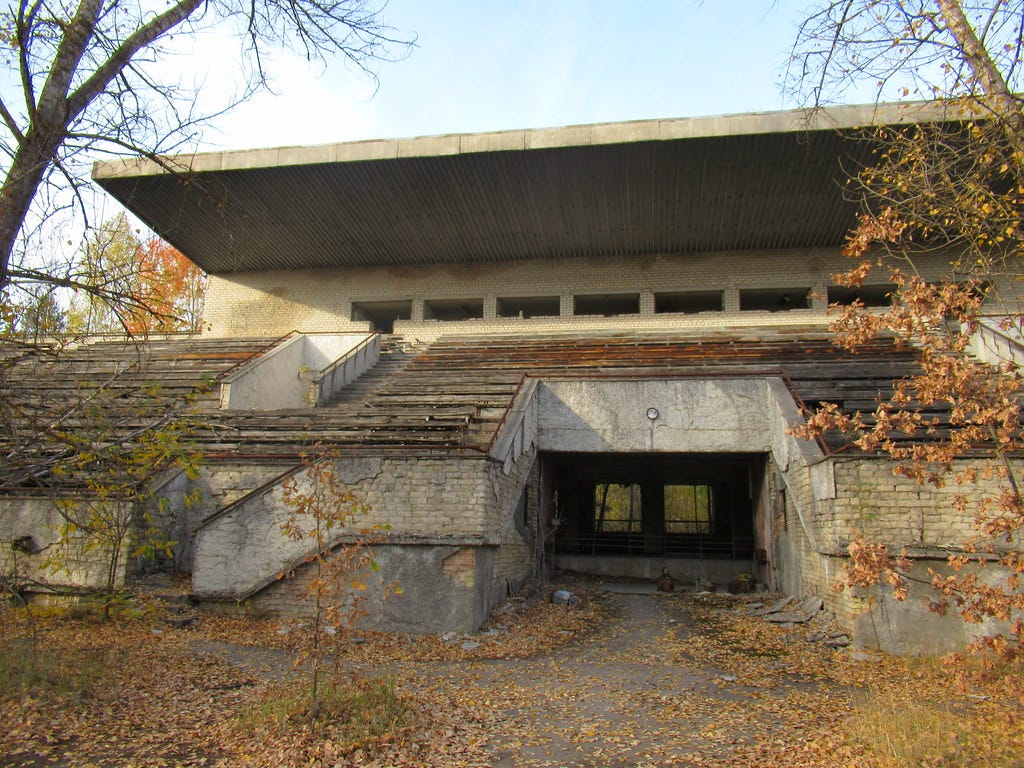
That belief was concrete enough, eventually, to justify concrete: a new stadium, the Avanhard, was commissioned and built on the edge of the city, with a capacity of five thousand, planned to open on the first of May 1986.
That never happened.
In the early hours of Saturday the 26th of April, 1986, Reactor Number Four at the Chernobyl Nuclear Power Plant exploded. The players of Stroitel Pripyat were, at that point, preparing for a cup semi-final scheduled for later that day, against FC Borodyanka.
They would not play it.
Within thirty-six hours, the order came to evacuate the city. Residents were told to take documents and essentials for three days. They left in buses, in an orderly fashion, having been given little indication that the three days would become permanent.
The city they left behind was already dying. What distinguishes the story of FC Stroitel Pripyat from others is the completeness of its ending; this was not a club that simply folded when the money ran out, but a city switched off at a single moment.
The football stadium still exists although the Avanhard Stadium, with its terracing still intact, never hosted a competitive match. Photographs of it circulate as a kind of haunted curio, the grass forcing its way through the concrete, the stands empty in a way they were always supposed to be temporary.
Some of the players returned as liquidators, joining the thousands of workers who were sent in to contain the disaster, to bury the graphite and hose down the rooftops and dig trenches in irradiated earth. What happened to those men in the years that followed is harder to document.
The club itself was relocated. A new city, Slavutych, was built near Chernihiv to absorb the displaced population of Pripyat, and the football team moved with them, renamed FC Stroitel Slavutych. They played on for two more seasons.
But by the end of 1988 it was over.
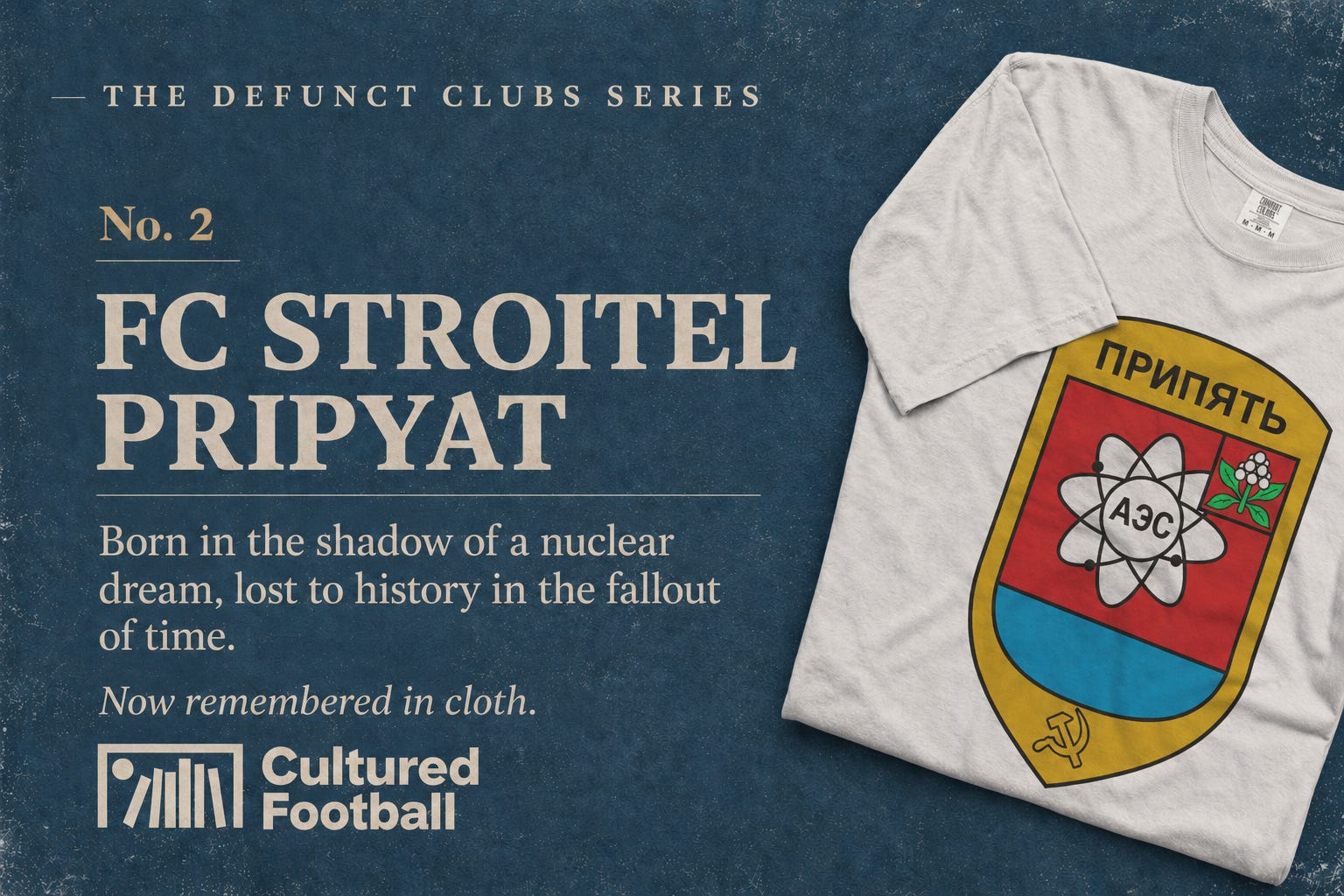
The story of FC Stroitel Pripyat is now captured in this exclusive Cultured Football shirt. Featuring its original badge and a brief history, if you enjoyed their story you can now own a piece of football’s forgotten past.
Each week on Cultured Football we pick the five great football stories from the previous seven days.

Excellent article. I had never heard of FC Stroitel Pripyat. The story behind the new stadium is incredible. This is exactly the kind of high-quality content I’m looking for on Substack. Thank you so much for sharing it Paul.