


There is no bigger danger for a football club than indifference. Once that takes hold, decline no longer provokes urgency or anxiety. The sense that something valuable is being lost disappears altogether. When the end does arrive, there is often nobody left willing, or able, to stop it.
That is what happened to Itzehoer SV.
By the time the club folded in 2018, after insolvency proceedings and years of financial instability, few even took notice. This was just another regional German football club slipping beneath the surface after decades spent fighting gravity.
And yet, like so many clubs buried deep within the lower reaches of German football, Itzehoer SV carried a proud history shaped by the country’s post-war reconstruction; one built on local ambition, economic recovery and fierce regional pride.
The club began life on 3 October 1909 as FC Preußen 1909 Itzehoe, when German football had little of the structure we would recognise today. Its identity shifted across the decades through a series of name changes and reorganisations, reflecting both ambition and the search for stability in a rapidly changing sporting landscape.
In 1945, and in the aftermath of the Second World War, Preußen merged with VfL Eintracht Itzehoe and SC Askania Itzehoe to form Itzehoer SV, a practical union that was shaped as much by necessity as by footballing ambition.
The timing proved unexpectedly fortunate.
In the immediate post-war years, Itzehoe benefited from one of the defining demographic movements of the era. Refugees from the former eastern German territories arrived in Schleswig-Holstein, among them several players from the once-prominent East Prussian side VfB Königsberg, a club displaced and ultimately erased by the redrawing of Europe’s borders.
It changed the club’s level almost immediately.
The late 1940s and early 1950s became Itzehoe’s golden years. Three consecutive Schleswig-Holstein titles between 1948 and 1950 pushed the club toward the summit of northern German football. They had gone close before. In 1947, they narrowly missed out on a place in the new Oberliga Nord. In 1948 and 1949, promotion play-offs again ended in frustration.
In 1950, under player-coach Kurt Baluses, they finally made it.
Their promotion to the Oberliga Nord represented much more than elevation to a higher division. Before the Bundesliga was founded in 1963, it was the highest level of football in northern Germany. This was the world of Hamburger SV, Werder Bremen, St. Pauli and other clubs with greater resources, deeper support, and a far more established place in the game’s hierarchy.
Now, Itzehoe stood among them.
It did not last. In 1950–51, Itzehoer SV finished seventeenth and were relegated immediately. The gap was often brutal. They lost 9–0 to Hamburger SV and 8–1 to Göttingen 05. By the end of the season, they were well short of survival and returned to amateur football.
But the significance of that campaign stretched far beyond the league table. In practical terms, it was probably unsustainable from the beginning. The economic and structural realities separating a club from Itzehoe from the major northern sides were already becoming visible. But that hardly mattered. For clubs of this size, a single season at the summit can sustain an identity for generations. It becomes proof that the impossible once happened.
And, maybe, could happen again.
For much of the 1950s and 1960s, the club remained strong within Schleswig-Holstein’s amateur leagues. They won another state title in 1954, came close again in promotion rounds, and remained one of the region’s serious football clubs. There was a particularly painful near-miss in 1952, when Itzehoe travelled to VfB Lübeck in front of 14,000 spectators and lost the decisive game late on, after a disputed corner that left the visiting players protesting on the pitch.
For clubs like Itzehoe, entire eras could turn on moments like that.
In 1965, Itzehoe returned to a wider stage by winning another Schleswig-Holstein championship and gaining promotion to the Regionalliga Nord. By then, the Bundesliga had already been created, which meant the Regionalliga was now the second tier. Even so, it still carried real weight. For a club from a rural town in Schleswig-Holstein, it was a considerable achievement.
They remained there for nine seasons.
There was something intrinsically German in their stay. Itzehoe never finished higher than twelfth, much less were they ever close to promotion. Most years were shaped by relegation battles and the constant problem of competing against clubs with more money and larger catchments. Survival was in itself was an achievement.
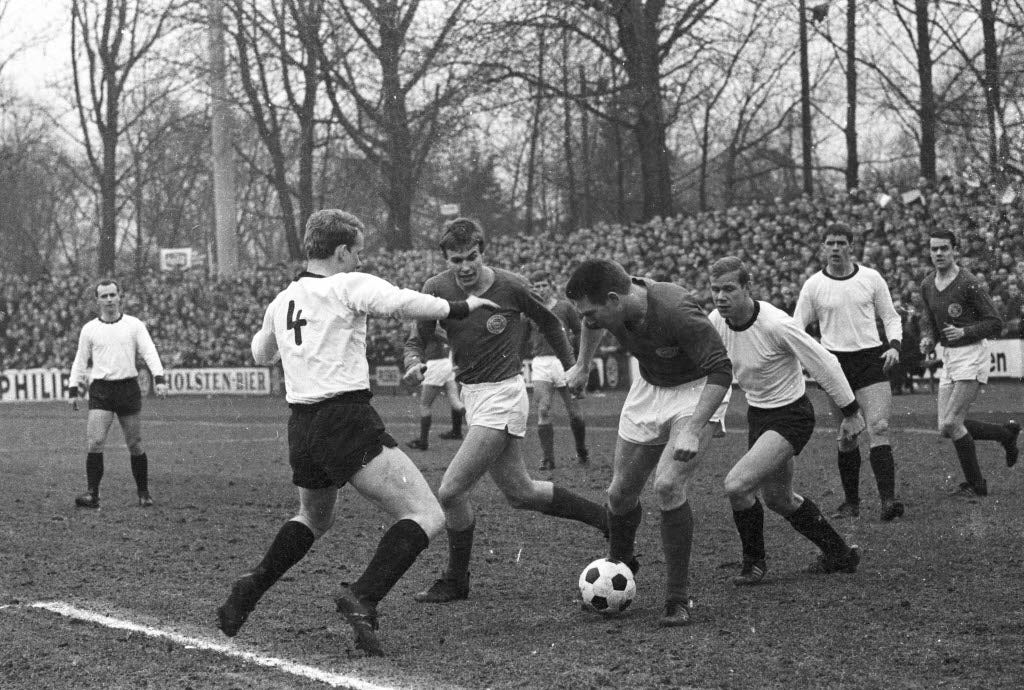
That era now feels almost impossible to imagine. Regional football in West Germany still carried genuine weight where crowds in provincial towns could be substantial. Travel remained local enough for rivalries to feel intimate, while semi-professional clubs could still believe, at least briefly, that persistence might narrow the gap to the elite.
Instead, the opposite happened.
The formation of the Bundesliga had already centralised German football economically and culturally. By the mid-1970s, the creation of the 2. Bundesliga accelerated the divide further. Clubs like Itzehoe increasingly found themselves stranded between ambition and infrastructure. Too large for purely local football, too small to survive the professionalisation swallowing the game above them.
When the Regionalliga Nord was disbanded in 1974, Itzehoe failed to qualify for the new second division. It was a defining turning point.
Each week on Cultured Football we pick the five great football stories from the previous seven days.
Still, Itzehoe did not disappear.
They entered the new Oberliga Nord, now a third-tier competition, and produced one of the quietly remarkable seasons in the club’s history. In 1974–75, Itzehoer SV finished eighth, ahead of both Holstein Kiel and VfB Lübeck. For one season, they were the highest-ranked club from Schleswig-Holstein. It was not as romantic as the single Oberliga Nord season of 1950–51, but in its own way it mattered. It showed that Itzehoe could still compete regionally, even as the game around them was changing.
The cup offered other brief returns to view.
Itzehoe made five appearances in the DFB-Pokal. The most memorable came in 1977–78, when they reached the second round after beating Borussia Brand before losing to SpVgg Bayreuth. The previous season brought a heavier but more evocative occasion: a tie against 1. FC Köln, then one of the major powers of German football, which ended in a 7–0 defeat.
Fleeting though they were, those cup appearances were vital. For clubs outside the elite, knockout football offers something league structures increasingly deny them: temporary equality. One afternoon where the distance between provincial amateur football and the national stage briefly disappears.
By the 1980s, though, the old pressures had begun to harden.
Itzehoe were relegated from the Oberliga in 1981, ending sixteen consecutive seasons above the Schleswig-Holstein state level. Debts weighed heavily. Attendances fell. The club remained competitive at times, winning further Schleswig-Holstein titles in 1985 and 1986, but the route back upward became harder each time.
Even so, the old fire remained. In 1994, Itzehoe became a founding member of the Oberliga Hamburg/Schleswig-Holstein, then the fourth tier. For a few more seasons, they held their place respectably, even finishing fifth in 1998–99.
But the underlying reality had not changed.
League reforms demanded more money, better facilities and stronger administration. Clubs like Itzehoe were increasingly asked to behave like professional organisations without possessing professional resources. Relegations and restructuring diminished them further, while financial strain became a recurring headache.
The eventual merger with Türk Spor Itzehoe in 2010, creating FC Itzehoe, was a last throw of the dice. German lower-league football is full of these mergers, awkward attempts to pool dwindling energy before decline becomes irreversible.
Even the reversion to the old Itzehoer SV name in 2015 carried a certain melancholy, as though the club understood that nostalgia might be the only remaining asset left to trade on.
By then, the economics no longer worked. The withdrawal of sponsors collapsed their budget transforming competing higher up financially impossible. The team had to be pulled back down the divisions, and though there was one final return to the Verbandsliga, it was not enough.
In January 2018, the club filed for bankruptcy. On 1 June 2018, insolvency proceedings were opened and Itzehoer SV was dissolved. A successor club, Itzehoer SV 2.0, emerged almost immediately, but it could only be a shadow of what had existed before.
Clubs like Itzehoer SV once occupied an important middle ground: ambitious regional institutions capable of touching national football without fully belonging to it. Over time, that middle ground became harder and harder to sustain.
What remains now are fragments. League tables. Old cup results. Stories of refugee footballers from Königsberg. A 9–0 defeat to Hamburger SV. A disputed afternoon in Lübeck. A cup tie against Köln. Photographs with terraces in the background and floodlights cutting through North German fog.
And one season, back in 1950–51, when a small club from Schleswig-Holstein briefly stepped into the highest level of northern German football and discovered, however fleetingly, what it meant to stand among the giants.
Honours
Schleswig-Holstein champions: 1948, 1949, 1950, 1954, 1965, 1985, 1986, 2005
Verbandsliga Süd-West champions: 2011
SHFV Cup winners: 1955, 1964, 1975, 1985
Schleswig-Holstein indoor champions: 2005
The story of Itzehoer SV is now captured in this exclusive Cultured Football shirt. Featuring its original badge and a brief history, if you enjoyed their story you can now own a piece of football’s forgotten past.
Great story and very similar to Blau Weiss, a club I watched in the late 80s.