“It’s better to burn out than to fade away.” Few lyrics have captured the romance of impermanence quite like those words from Neil Young’s *My My, Hey Hey (Out of the Blue)*.
It’s a line usually reserved for musicians, artists and larger-than-life figures whose brilliance burned bright before disappearing. Through it, Young gave us one of popular culture’s most enduring reflections on legacy: that perhaps there is something admirable about a life that shines intensely, even if only briefly.
Football, of course, tends to see things differently. A player who explodes onto the scene before fading almost as quickly is rarely remembered as a success. More often than not, they become a cautionary tale; a career forever framed by what might have been. In football, greatness is measured not just by how brightly you shine, but by how long you can keep the light burning.
The same is true of clubs, only more so. Players come and go, managers are replaced and owners change, but clubs are expected to outlive them all. Their identity is built over generations, accumulating memories, traditions and supporters with each passing decade. Survival is almost taken for granted. Even those that suffer relegation, financial collapse or years in the wilderness are expected, somehow, to endure.
Which is why the story of Jokerit is so unusual.
Each week on Cultured Football we pick the five great football stories from the previous seven days.
Like any good story, this one begins somewhere unexpected: not on a football pitch, but inside a brand-new ice hockey arena. When Finnish businessman Hjallis Harkimo completed Hartwall Arena in 1997 as the new home of Jokerit’s ice hockey team, he inadvertently set in motion a chain of events that would bring together not one but two football clubs.
The starting point was PK-35, a club with roots stretching back to 1935. Founded in Vyborg before being re-established in Helsinki after the Second World War, PK-35 had worked its way into the Veikkausliiga during the 1990s.
Success on the pitch, however, masked growing financial problems. By the end of the decade the club was struggling to survive. That was when Hjallis Harkimo entered the picture.
Although a lifelong HJK Helsinki supporter, Harkimo saw an opportunity. Jokerit’s ice hockey team commanded one of Finland’s largest and most passionate fanbases, but for much of the year those supporters had no team to follow. Why not create a football club that could carry the Jokerit name through the summer months?
Rather than starting from the bottom of the pyramid, Harkimo acquired PK-35’s Veikkausliiga licence and first team, rebranding them as FC Jokerit despite initially promising that PK-35 would not lose their identity. The original PK-35 survived, continuing with its youth and lower-division sides, but Finland’s topflight suddenly had a brand-new club that had never actually earned promotion.
There was also a more practical motivation. Harkimo was leading the development of a new 10,000-seat football stadium in Töölö, financed through a mixture of public and private investment. HJK would be the anchor tenant, but a second football club would help justify the project, fill the fixture calendar and strengthen the stadium’s commercial viability.
Initially, the plan was for FinnPa to do that. When that side was relegated in 1998, their main backers Finnair pulled out and the club was dissolved. The void was filled by FC Jokerit.
At first, the idea seemed inspired. They won their first-ever Veikkausliiga match, finished fourth in their debut season and, most significantly, lifted the Finnish Cup by beating FF Jaro 2-1 in the final.
Alongside this there was a good run in the Intertoto Cup where Jokerit were only eliminated by West Ham in the third round.
A year later, when playing in their new stadium they kept improving, finishing as runners-up in the league. The team had been considerably strengthened – Shefqi Kuqi, who would go on to enjoy a fine career in England, was the main addition – and the ambition of dethroning HJK seemed within reach.
Yet second would be as good as it got.
Things broke down quickly after that. A year later they were relegated, losing the decisive match against FF Jaro, and despite an immediate return to the topflight it was clear that the old ambition was gone. They survived one more Veikkausliiga season, achieving the modest objective of avoiding relegation, but that proved to be the end. Hockey fans hadn’t transferred they sympathies and the club was losing money.
Once the campaign was over, Harkimo sold the football operations to HJK Helsinki. The club was rebranded as Klubi-04 and moved to the third tier, where it became HJK’s reserve team. Just six seasons after playing their first league match, FC Jokerit had ceased to exist.
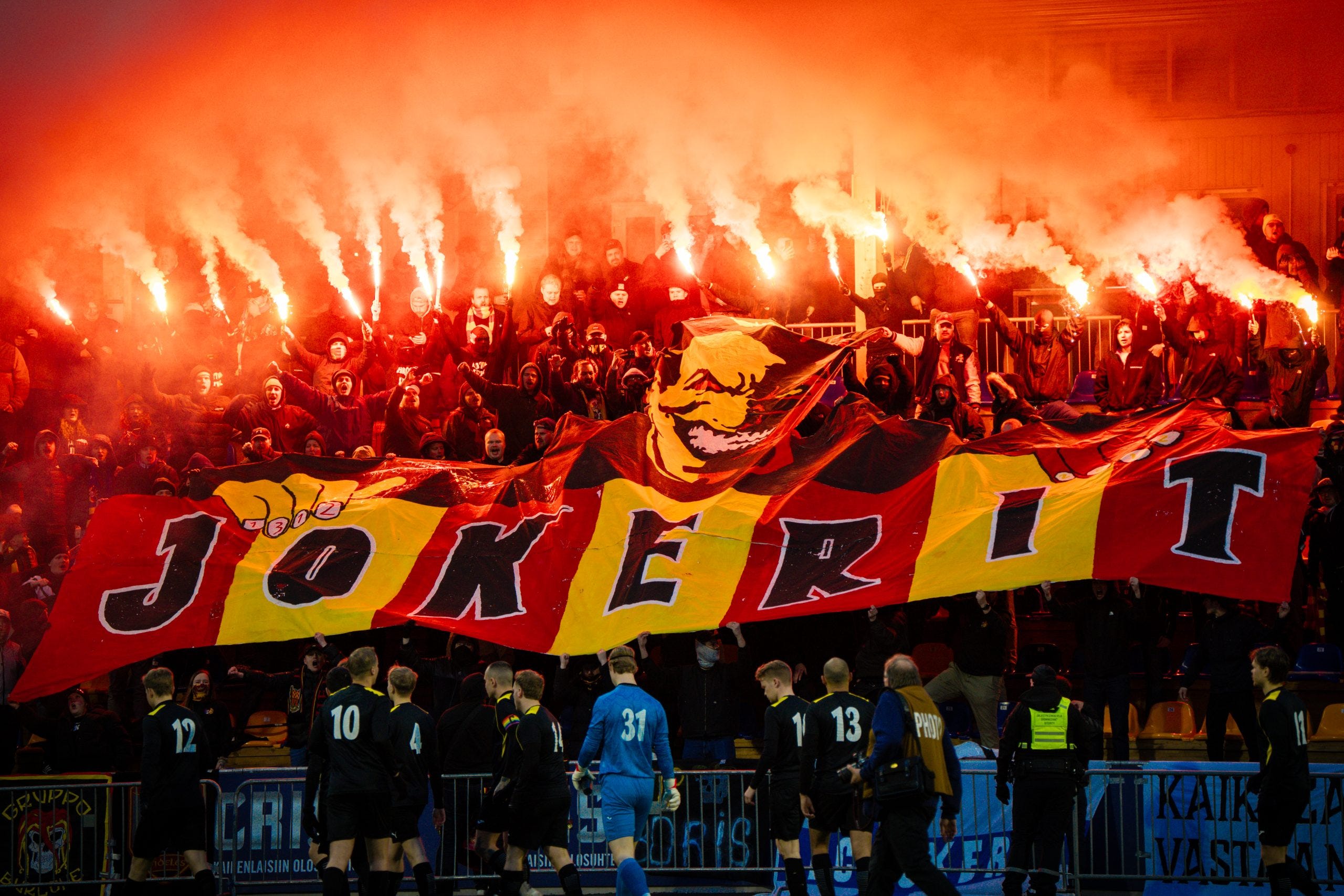
FC Jokerit compressed almost an entire life cycle into six extraordinary years: rapid success, cup glory, European nights, relegation and eventual extinction. It never became what Harkimo had imagined, but it had still been pretty eventful. In 2012, supporters founded a phoenix club, Jokerit F.C. Helsinki, determined that the name would not disappear entirely. But the original experiment was over.
* The original PK-35 did not disappear. Instead, it continued with its junior and amateur sides, gradually climbing back through the divisions until it once again reached the professional ranks.
The story of Jokerit FC is now captured in this exclusive Cultured Football shirt. Featuring its original badge and a brief history, if you enjoyed their story you can now own a piece of football’s forgotten past.