Wherever you go in the world, clubs from capital cities tend to feature prominently in the domestic football leagues. Unsurprisingly perhaps, given that these cities also tend to be the financial centres of those countries. Even in those countries where capital city clubs don’t dominate league title success, as in Italy or Germany, they still tend to feature at least one prominent club.
Still, few capitals dominate their domestic football landscape quite like Tallinn.
Estonia’s capital is home to the country’s most successful clubs, and its influence extends far beyond the top division. Much of Estonian football’s history has been written in Tallinn, with clubs emerging, merging, changing names and, in some cases, disappearing altogether.
All of the 35 Estonian league championships contested since the country regained independence in 1991 have been won by clubs from Tallinn or its immediate surroundings; of the 19 championships contested before the Second World War, 18 were won by Tallinn clubs.
Only once, then, did the title leave the capital.
That exception came in the 1939–40 season, when Tartu Olümpia became the first - and, so far, only - club from outside Tallinn to win the Estonian championship.
Founded just a decade earlier, in 1930 by football enthusiasts and businessmen who wanted to revive football in the city, Olümpia represented Tartu, Estonia’s second-largest city and a place better known for its university and intellectual traditions than its footballing achievements. Despite its size and importance, Tartu had struggled to establish a meaningful presence in the country’s top division, with its clubs making only occasional appearances.
The club initially struggled to establish itself in the top division, finishing bottom in its first campaign and failing to win a single match the following season. Relegation followed, and for a time it appeared that Olümpia would become just another provincial club unable to challenge Tallinn’s dominance.
Yet the club gradually rebuilt. By the 1938–39 season, Olümpia had returned to the highest division, where a sixth-place finish hinted that it was finally beginning to find its feet.

What helped change their fortunes was the financial backing of Karl Jänes, a wealthy Tartu businessman and department store owner who was determined to establish Olümpia among Estonia’s leading clubs. With his support, the club was able to strengthen its squad considerably, bringing in experienced players capable of competing with the best in the country.
The most significant addition was Richard Kuremaa, who returned to Tartu in 1939 after a spell with JS Estonia Tallinn, where he had won the national championship in 1937–38. Kuremaa was already an established Estonian international and one of the country’s most accomplished forwards. His return gave Olümpia a proven goalscorer and, perhaps just as importantly, a player who knew what it took to win a league title.
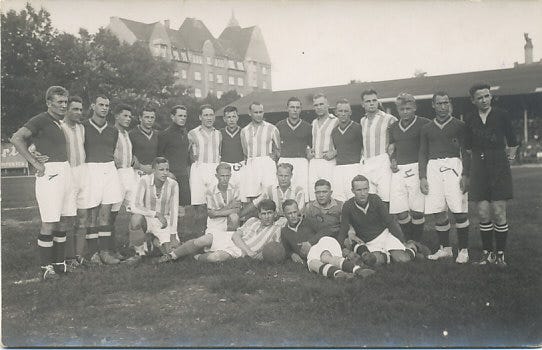
He was joined in the championship-winning side by other players of considerable experience, including Viktor Sieger and Aleksander Kõss, both of whom had represented Estonia internationally during the 1930s. The squad also featured Otto Lõhmus, who had been Olümpia’s leading goalscorer during the previous campaign, and Boriss Riisik, who would emerge as one of the team’s most important attacking players. Together, they formed the nucleus of a side that was considerably stronger than the one which had struggled to establish itself in the top division just a few years earlier.
There was experience on the touchline too. Karl-Richard Idlane, who had taken charge in 1937, was a former Estonian international and five-time national champion with Tallinn Sport. Having spent his playing career with one of the capital’s most successful clubs, he understood what was required to compete at the highest level.
The transformation was remarkable. Having finished sixth in 1938–39, Olümpia entered the following campaign with ambitions that would have seemed almost unthinkable only a few years earlier. Yet their season began inauspiciously, with a 3–0 defeat against Tallinn Sport.
Each week on Cultured Football we pick the five great football stories from the previous seven days.
That defeat could have killed their ambitions but instead it proved to be their only league defeat of the campaign.
Over the remaining thirteen matches, Olümpia recorded nine victories and four draws. Kuremaa scored 13 league goals, while Riisik contributed another nine, giving the Tartu side an attacking partnership capable of troubling even the strongest defences in the country. By the final round, Olümpia were on the verge of breaking a monopoly that had lasted throughout the history of the Estonian championship.
On 7 July 1940, a 3–1 victory over Tallinn Kalev completed the achievement even though it was a close run:. Olümpia finished a point ahead of JS Estonia Tallinn.
For Jänes and the people of Tartu, it was an extraordinary triumph. A club that had failed to win a single match in the top division just five years earlier was now the best team in Estonia. But the timing of their success could hardly have been more unfortunate. For, as Olümpia celebrated its historic achievement, Estonia was already undergoing a political upheaval that would change the country beyond recognition.

For much of the interwar period, Estonia had existed as an independent republic, having secured its independence from Russia in 1918 and successfully defended it during the subsequent War of Independence. Like its Baltic neighbours, Latvia and Lithuania, it had spent the following two decades attempting to establish itself as a sovereign European state, developing its own institutions, economy and national identity.
By the late 1930s, however, Estonia’s position had become increasingly precarious. The country was caught between two powerful neighbours, Nazi Germany and the Soviet Union, neither of which was particularly concerned with the independence of the small states along the Baltic coast.
In August 1939, the Molotov–Ribbentrop Pact between Nazi Germany and the Soviet Union secretly placed Estonia within the Soviet sphere of influence. Following Germany’s invasion of Poland, Estonia was pressured into allowing Soviet military bases and troops on its territory, severely undermining its independence. Within a few months, Estonia was formally incorporated into the Soviet Union.
It meant that when Olümpia defeated Tallinn Kalev on 7 July, the Estonia in which the club had been founded was already disappearing. Their championship was secured under Soviet occupation, just weeks before the country ceased to exist as an independent state.
For the players and supporters, the achievement must have carried a strange mixture of emotions.
The consequences for Estonian football were immediate. The sporting institutions that had developed during the years of independence were subjected to the new Soviet authorities, and clubs associated with the country’s previous social and political order faced an uncertain future. Olümpia, whose rise had been made possible by private initiative and the financial support of a local businessman, belonged to a footballing world that was rapidly dismantled.
The club was dissolved in 1941, barely a year after its greatest achievement. There would be no opportunity to defend the championship, much less the chance to build a lasting rivalry with Tallinn’s established powers.
Estonia itself would endure further upheaval. Nazi Germany occupied the country in 1941, before Soviet forces returned in 1944. Independence would not be restored until 1991, more than half a century after Olümpia’s triumph.
When independent Estonian football finally resumed, Tallinn’s dominance resumed with it.
Olümpia’s achievement remains an isolated exception, a championship won by a club from outside the capital in the final weeks of an independent Estonia. Still, the club never returned from its forced dissolution.
Football has not disappeared from Tartu. JK Tammeka have been a fixture in Estonia’s top division since 2005, while JK Welco have just secured promotion for the first time, ensuring that the city will have two representatives among the country’s elite in 2027.
Yet neither club has managed to emulate Olümpia’s achievement. More than eight decades later, the championship won in the summer of 1940 remains Tartu’s only national title.
Honours Won:
Estonian Championship: 1939-40
The story of Tartu Olümpia is now captured in this exclusive Cultured Football shirt. Featuring its original badge and a brief history, if you enjoyed their story you can now own a piece of football’s forgotten past.