


It is difficult now to think of Spanish players in English football as anything unusual. But when Rafa Benítez arrived at Liverpool in the summer of 2004, the relationship between the two football cultures looked very different.
What followed was remarkable. Benítez surrounded himself with Spanish coaches and staff and brought in a succession of players from La Liga. Some, like Xabi Alonso, Pepe Reina, Luis García and Fernando Torres, became hugely important figures at Anfield. Others enjoyed considerably less success. Together, though, they helped create an era in which Liverpool developed an unusually strong connection with Spanish football.
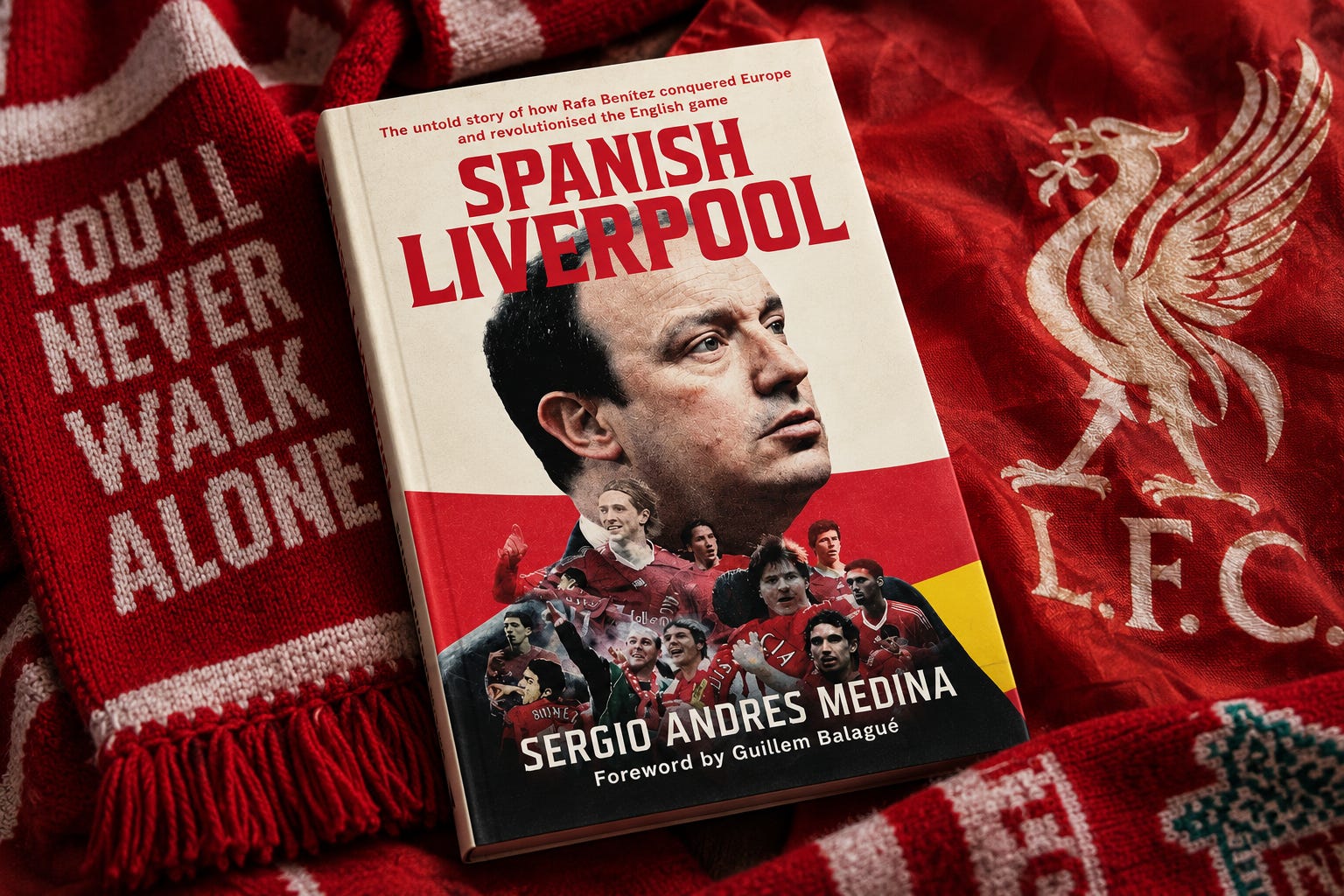
It is that period that Sergio Andrés Medina explores in his book Spanish Liverpool, looking beyond just the familiar names and famous nights to tell the stories of the players, coaches and other figures who formed part of what became a distinctly Spanish chapter in Liverpool’s history.
I spoke to Sergio about why that connection developed, the influence Benítez had beyond simply signing Spanish players, why some adapted better than others, the importance of the less celebrated pioneers, and whether Istanbul really did change everything.
What made you want to write Spanish Liverpool?
Well, I am a journalist and I had always wanted to write a book about this team and these players, especially because in those days many of them were Spaniards. Since I was a teenager, maybe even before, Liverpool had always caught my eye. I didn’t know why, but there was something special about it: the city, The Beatles, that team of pioneers in 2004.
Then Fernando Morientes, who was one of my idols in those years, joined the club. Although I’m a Real Madrid fan, Liverpool became a kind of second team for me to support.
What did Benítez understand about Liverpool that allowed him to establish such a strong connection with the club and its supporters so quickly?
Maybe, in this case, Istanbul changed everything and allowed Benítez to spend so many years at Liverpool. That first season, 2004-05, was quite difficult and, in some ways, the European success gave him credit, trust and confidence from the media, the supporters, the boardroom and even the players.
It seems to me that, without Istanbul, that connection with the city, the club, the fans and the community wouldn’t have been possible, because I don’t know how long he would have stayed there otherwise.
Benítez brought more than Spanish players with him. How much did he change Liverpool’s approach to coaching, tactics, recruitment and preparation?
He was already a pioneer in his training methods. He was different from most managers in Spain back in the early 2000s, so when he got there, the players didn’t understand or like those training sessions.
In some ways, he was more of a teacher and an innovator than a coach, and this caught everyone’s attention. But the thing is that those new methods eventually paid off, and many other managers and coaches, not just in England, used them.
If we talk about recruitment, I’d differentiate between two things: the budget and the language. Like Houllier, he wanted to sign a few of his countrymen, or players who understood the Spanish language, such as Aurélio and Mascherano, in order to make things easier. This was especially true in his first season, with García, Josemi, Alonso, Morientes, Núñez and even Pellegrino. The same applied to his assistants: Herrera, Ayestarán and Ochotorena, people he had already worked with and known for several years.
The limited budget he had at his disposal was the reason he signed players for both the senior squad and the reserves with the idea of selling them in the future and making a profit. On many occasions, his signings were players who were affordable because of their price rather than his first choices. For instance, Torres was a first choice; Núñez was not.
Was there resistance to those changes? Looking back at how Benítez and some of his Spanish players were discussed, was there a suspicion of continental football in England that has largely disappeared today?
The main resistance came from the players, the ones who ruled the dressing room. Just take a look at the Netflix documentary The Miracle of Istanbul. Carra, Gerrard and even Owen, in his first conversations, didn’t understand his ideas and methods. They all say that Rafa was different.
Talking about the first signings, it’s clear that neither Josemi nor Núñez had the same pedigree as Alonso, Morientes, Reina or Torres, for example. But it’s fair to say that Josemi was the first one, and that is always difficult. Another language, another climate and he was alone. He played everything until he got injured and lost his place to Finnan.
Núñez was a fine player, but two things are key. He came as part of Michael Owen’s transfer to Real Madrid and the fans were angry about that, especially because of the price of Owen and because Núñez had not been an important player at the Bernabéu. Later, he got injured at Melwood in his second training session and couldn’t show his true level.
But they were both good players and played their part in the Spanish Liverpool story. Later, for Torres or Riera, among others, it was “easier”. They played so well and performed superbly, but it was also a bit easier because the door had already been opened.
Why did so many Spanish players seem to connect particularly strongly with Liverpool? Was there something about the club or city that made the transition easier?
Istanbul changed everything. Once Benítez’s project found stability and was able to develop its potential, many other Spaniards jumped on the bandwagon, not just at Liverpool but in other big cities, Manchester and London above all. Just look at Mata, Silva, Cazorla, Bellerín, Negredo, Pedro, Azpilicueta…
Of all the Spanish players Liverpool signed during that period, who do you think had the greatest influence on the club?
Every one of them played their part, but Torres, for me, was the best of them. He was superb over there and had his best seasons ever. And, curiously, he was trophyless!
Alonso and Reina also had a great influence and must be considered legends. People have fond memories of them, but Torres was on a higher level. At least from my point of view.
And whose contribution has been most underrated? Is there someone whose Liverpool story deserves more recognition than it generally receives?
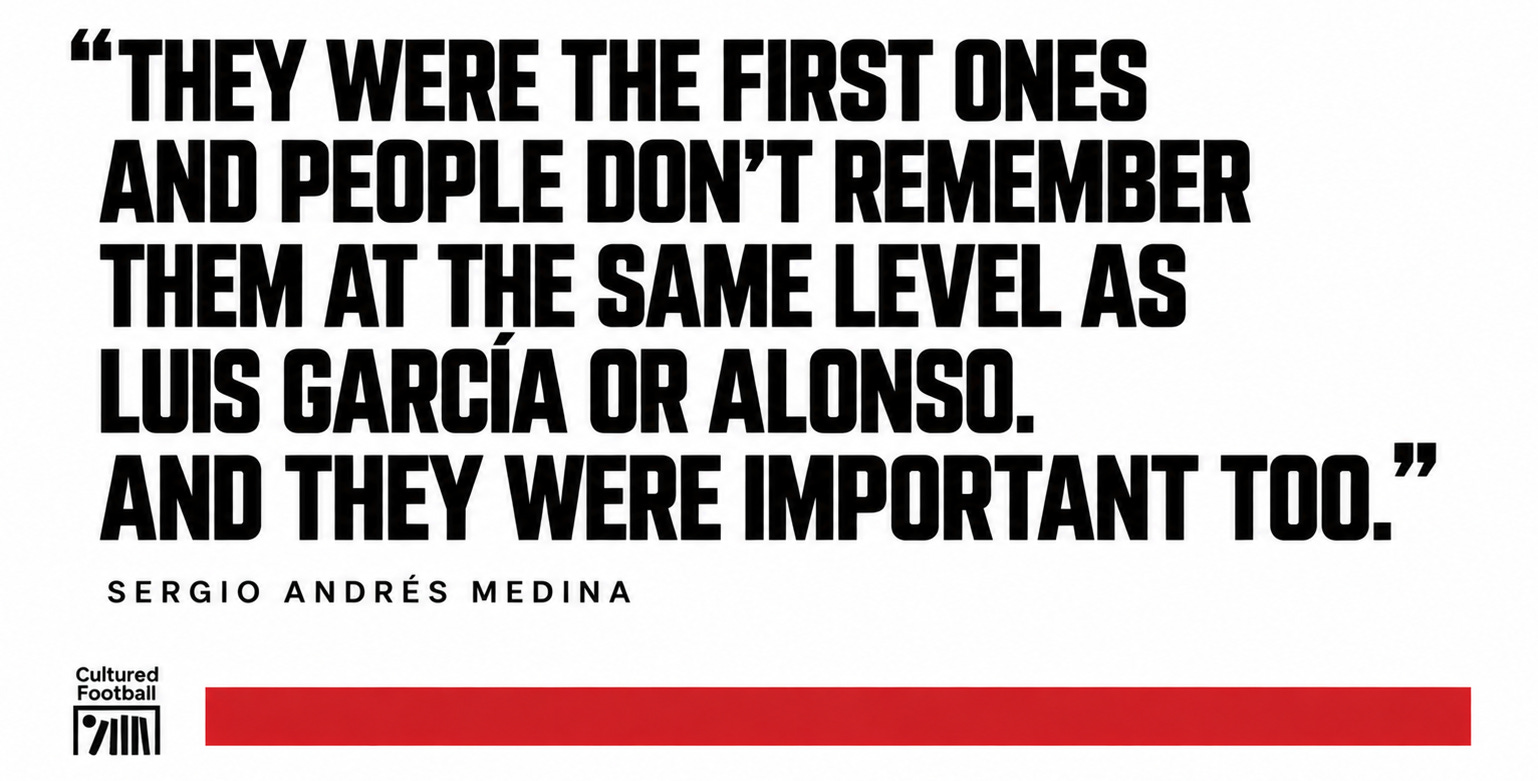
As I always say, Núñez and Josemi. They were the first ones and people don’t remember them at the same level as Luis García or Alonso. And they were important too.
Also Morientes. He was a fine striker but he couldn’t compete at his best. But all five were members of the original Spanish Liverpool and deserve credit and recognition.
Were there players you began researching with one impression of and ended up viewing completely differently?
We all knew Reina was a good goalkeeper and a future prospect as one of the best in his position, but he exceeded all expectations. In just one season, he became one of the leaders of the dressing room.
The “pity”, at least for me, is that I think he could have spent more seasons on Merseyside. Just take a look at his career.
We inevitably remember Alonso, Torres, Reina and García, but there were plenty of Spanish signings who didn’t succeed. Did you identify any common reasons why some adapted and others didn’t?
There were a few: the language, the weather, the injuries… Here in Spain, referees are stricter. In England, they allow more. But above all, the injuries. Morientes, Josemi and Núñez got injured in their first months.
Torres was also prone to injury, but not in his first season.
The city is also a bit different nowadays compared with those years, so their families had to be comfortable too, and some of them were alone. Being alone abroad while your relatives are in Spain is difficult too.
English football traditionally carried stereotypes about Spanish players — technically gifted but perhaps too lightweight for the Premier League. Did that generation at Liverpool help change those attitudes?
I don’t think so. As Sid Lowe says in the book, we all thought Morientes was the perfect stereotype for British football: strong, good in the air, quite powerful. But later, the ones who succeeded were los bajitos, “the tiny ones”: Cazorla, Silva, Mata, Navas, Pedro Rodríguez or even Thiago Alcántara.
I think that generation changed the mentality for us Spaniards, as fans and journalists, and certainly for the footballers.
There is inevitably a lot of nostalgia surrounding Benítez, Istanbul and that generation. Does romanticising the period obscure some of its tensions, disappointments and failures?
Yeah, maybe. But from the beginning, it’s clear that there were plenty of ups and downs in those years. There were successes but also failures.
The thing is that some of those “failures”, such as the 2008-09 season, instead of being remembered as a disappointment, are recalled as almost perfect seasons. That season, the squad thrashed both Real Madrid and Manchester United.
But yes, there were business issues that affected the team, especially the arrival of the American owners, and there is the idea that Liverpool could have earned more silverware in those years.
Benítez’s relationship with Liverpool became about much more than football, particularly during the ownership battles. Is it possible to separate the affection for Benítez the manager from what he eventually came to represent to supporters?
People on Merseyside have loved Benítez since he made Liverpudlians think and believe that they could compete against anyone, especially in those years against that United, Chelsea and even Arsenal. With the obvious differences, it was the kind of philosophy Jürgen Klopp later used.
He has continued living there and has been very committed to the city in many ways, even raising funds and proceeds for charities.
The supporters protected him and showed their support because it was clear that the Americans were unfair to him. But again, part of the reason for that was the night in Istanbul.
When speaking to the Spanish players and coaches, did you notice differences between how they remember that period and how Liverpool supporters remember it?
They all remember those years quite fondly. It was tough and tricky in the beginning, but everyone is well aware, and proud, of what they achieved, even the ones who didn’t get the headlines or were in the shadows, such as Rafa’s assistants.
The supporters obviously focus more on and remember the famous ones, like Alonso, Luis García or Torres. Not everyone recalls the cases of Núñez or Josemi and the difficulties they faced. That is one of the reasons I wrote the book. They all deserve credit.
For instance, in my country there were supporters who didn’t remember Arbeloa playing for the Reds. In football, the memory is very short.
Football history tends to be written around managers, transfers, matches and trophies. Having researched this story, what do you think actually causes the culture of a football club to change?
The Bosman ruling changed football in the nineties. Later, during the COVID months, more substitutions were introduced during a game. Investors from Arabia, Asia or Qatar, the new rules, VAR… the culture of football is changing for the worse.
It seems to me that football is not what it used to be. It’s a pity there are no English players in the LFC line-up. The same happens, for instance, with Real Madrid: almost no Spanish players at all. It’s a shame.
Could something similar happen today? With sporting directors, recruitment departments, analytics and managers generally having less control over transfers, could one coach reshape a club culturally in the way Benítez did?
I don’t think so. For all those reasons, Benítez was the first one. The pioneer. The revolutionary, as Guillem Balagué said. The one who opened the door.
What was the biggest surprise you uncovered while researching the book — something you hadn’t expected when you started?
When I travelled to Liverpool to interview Rafa, I discovered the real passion and affection of the supporters. People in their seventies and older really support and love the team! I also discovered the importance of Benítez in the city and in the English game.
And when I talked, for instance, to Morientes, Núñez, Benítez and Ochotorena, they had all been at Real Madrid in different roles, and all of them told me that Liverpool is no smaller than Real Madrid. They also all highlighted Anfield as a temple.
Another thing was the magnetism the city has for those who have lived there. I remember the stories Herrera and Ochotorena told me, and they had goosebumps when they recalled those years. So did I when I listened to their passion!
Was there one interview, anecdote or individual that fundamentally changed how you understood the story you were writing?
All the interviews were special, but the most important and the longest was the one with Rafa Benítez. What a privilege!
But I have good memories of every one of them: the first one with Núñez, which is always special; the one with Iván Campo; the one with Matt Ladson in English; the one with Vicente del Bosque…
Having spent so much time researching it, do you believe there really is something distinctive about the relationship between Liverpool and Spanish football, or did an extraordinary manager and an extraordinary generation of players simply make it feel that way?
I think it’s special and distinctive because of the Istanbul comeback. Because of all the people from Spain who were involved in those years. Not just the footballers, but the coaching staff, the employees at the club, the lads in the reserve team…
Also, that Liverpool team was important in changing the mentality, and in part the fate, of the Spanish national team. Just remember, four or even five guys from that LFC team were regulars for Spain in those years: two Euros and a World Cup.
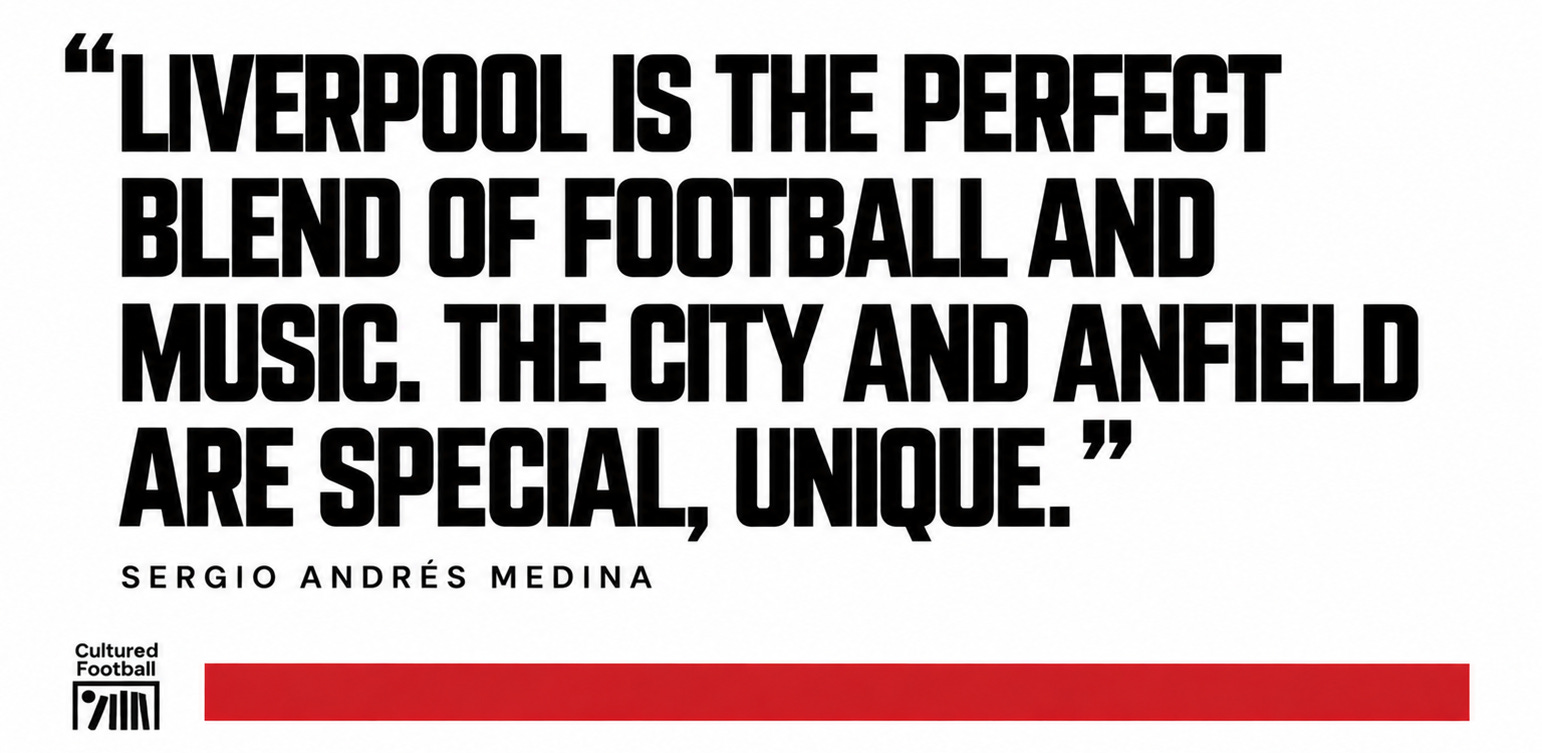
But I think the city itself is key to this recipe. Liverpool is the perfect blend of football and music. The city and Anfield are special, unique. I’m not sure if this could have happened in another city. Surely it could have, but without that charm and magic.
About the book: Spanish Liverpool: The untold story of how Rafa Benítez conquered Europe and revolutionised the English game tells the story of the remarkable Spanish influence on Liverpool during Rafa Benítez’s time at the club, an era that began with his arrival in 2004 and would transform both Liverpool and perceptions of Spanish football in England.
Sergio Andrés Medina looks beyond the obvious success stories of Fernando Torres, Xabi Alonso, Pepe Reina and Luis García to explore the wider group of players, coaches and staff who formed part of the Spanish contingent at Anfield. That includes those whose Liverpool careers did not go according to plan, but who nevertheless played their part in opening the door for those who followed.
At its heart is the story of Benítez himself: the methods and ideas he brought from Spain, the extraordinary triumph in Istanbul during his first season, his battles on and off the pitch and the relationship he developed with Liverpool and its supporters.
Featuring contributions from many of those involved, Spanish Liverpool is the story of a period when the connection between one English club and Spanish football became something much deeper than a collection of transfers. You can buy the book here.
About the author: Sergio Andrés Medina is a Spanish journalist and the author of Spanish Liverpool: The Untold Story of How Rafa Benítez Conquered Europe and Revolutionised the English Game.